Feature Flags: Ship Faster Without Blind Risk

on this page ▾
A checkout redesign can look perfect in staging and still cut completed purchases by 12% after release. The code may be correct. The failure is operational: the team shipped to everyone before it had enough real behavior to judge the change. Feature flags give teams a safer way to release, observe, and respond before a small problem becomes a revenue problem.
Used well, a flag is not just an engineering switch. It is the connection between a product decision and the customers affected by it. Product can see whether activation improved. Support can identify who encountered a broken path. Growth can message people who qualify for a new experience. Engineering can turn the change off without waiting for a redeploy.
That only works when the rollout system and the customer data tell the same story. If analytics, messaging, replay, and release controls all hold different identities or event definitions, teams still spend the critical hours stitching evidence together.
What feature flags actually change
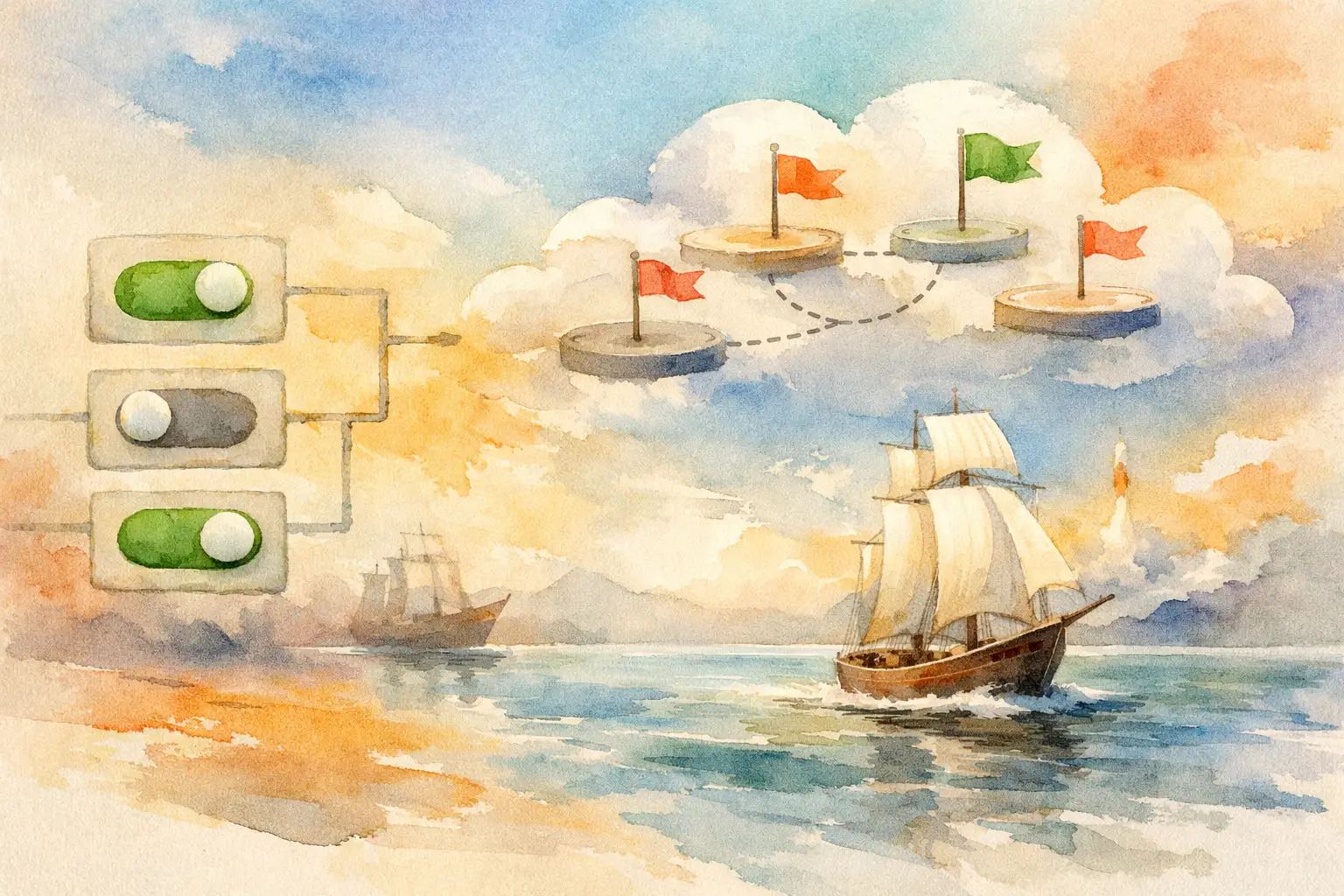
A feature flag separates deployment from release. Engineers can deploy code behind a condition, then decide who sees it based on attributes, cohorts, or a controlled percentage of traffic. The practical result is that code can reach production without immediately changing the experience for every customer.
That distinction matters because deployment answers an engineering question: is this code available in the production environment? Release answers a product question: should this customer see it now? Treating those as separate decisions gives teams room to learn.
Consider a new AI-assisted report builder. Rather than launch it to the entire account base, a team might first enable it for internal users, then a handful of design partners, then 5% of eligible workspace admins. At each stage, they can measure report creation, time to first value, error rates, support contacts, and downstream retention. If the experience causes confusion, the flag goes off. No emergency patch. No broad rollback. No guesswork about who saw what.
Feature flags are especially useful for four kinds of work: gradual releases, targeted betas, experiments, and kill switches. Those categories overlap, but they should not be treated as interchangeable.
A gradual release reduces blast radius. A targeted beta gives a defined customer group early access. An experiment compares intentional variants against a success metric. A kill switch disables behavior when an external dependency, performance issue, or defect creates immediate risk. Calling every flag an experiment creates false confidence. If there is no hypothesis, control group, or decision rule, it is a rollout, not an experiment.
Feature flags need behavior, not just percentages
Percentage rollouts are useful, but 10% of traffic is not always a meaningful audience. Ten percent may overrepresent new visitors, low-value accounts, one geography, or a single browser version. A release can appear healthy at the aggregate level while creating a serious problem for the customers who matter most.
The better question is not only, “What percentage has this feature?” It is, “Which people have it, what did they do next, and how did the outcome differ?”
For a SaaS onboarding change, segment by plan, company size, acquisition source, and whether the person is new or returning. For ecommerce, distinguish first-time shoppers from repeat buyers and compare the checkout funnel by device. For a marketplace, watch both sides of the transaction: a seller workflow may increase listing completion while making buyer discovery worse.
This is where fragmented stacks fail under pressure. Analytics shows a funnel drop. Session replay has the evidence, but the user IDs do not match. The messaging tool can reach an audience, but only after a CSV export. Engineering has the flag state in another system. By the time the team joins the dots, the release has affected thousands of people.
A one-source-of-truth setup changes the workflow. The same verified identity and event history used to measure a rollout should also identify the rollout audience, show the supporting session behavior, and power the next action. Find the leak, see why, then fix it without rebuilding audiences or reconciling dashboards.
A release workflow that produces decisions
Feature flags work best when teams define the operating plan before code reaches production. The goal is not ceremony. It is to avoid debating basic facts after the metric moves.
Start with a measurable release hypothesis
Write down what should improve, who should benefit, and what would make the team pause. “Customers will like the new navigation” is too vague. “New workspace admins will create their first project 15% faster without increasing help requests” can be measured.
Choose one primary outcome and a small number of guardrails. For a pricing-page change, the primary metric might be trial starts. Guardrails could include payment failures, page performance, and refund requests. Too many metrics create room to rationalize any result. Too few can hide real harm.
Also decide the observation window. A performance regression may be visible within minutes. A retention effect may take weeks. The correct rollout pace depends on the risk, traffic volume, and time needed to observe the outcome.
Target an intentional first cohort
Do not default to random traffic when a better first audience exists. Internal teams, opted-in beta users, customers with a known need, or accounts with a customer success contact can provide faster and more useful feedback. They are not statistically representative, but that is acceptable when the first goal is finding obvious defects and usability failures.
Then expand to a cohort that represents real production conditions. Keep flag assignment stable for each person whenever possible. If a user sees one experience on Monday and another on Tuesday, you can contaminate both the analysis and the customer experience.
Watch the path, not only the headline metric
A conversion number tells you that something changed. It rarely tells you why. Pair the metric with event sequences, errors, session replay, survey responses, and support conversations.
Imagine a new account setup flow holds activation steady but increases time on page. That could mean people are thoughtfully configuring more options. It could also mean a modal is blocking the primary button on smaller screens. The funnel alone cannot answer that. The behavioral timeline can.
When teams can inspect the affected cohort immediately, they stop arguing from averages. They can see whether users rage-clicked, abandoned after an error, asked support the same question, or completed the task after a short delay. That is the difference between reporting a problem and diagnosing one.
Define the next action before the rollout starts
Every rollout should have clear conditions for expand, hold, roll back, or contact customers. If trial conversion rises but support volume doubles, who decides whether to continue? If an account is blocked by a defect, can support identify its flag state and turn off the experience? If a new feature is underused, can growth message only the customers who have access but have not adopted it?
Kilden is built around this connected workflow: a funnel cohort can become the audience for an in-app message, campaign, support interaction, or controlled flag rollout without moving data through five separate tools. The point is not to add another dashboard. It is to make the evidence actionable while it still matters.
The trade-offs teams should not ignore
Flags introduce operational complexity. Every flag adds a branch in the product, a configuration surface, and a future cleanup task. Long-lived flags can create dead code, inconsistent states, and tests that are difficult to reason about. A flag system without ownership becomes a feature graveyard.
Treat each flag as a temporary product asset with an owner, purpose, expiration expectation, and removal plan. Release flags should usually disappear after the rollout is complete. Permanent entitlement or plan-access controls are different, but they still need clear naming and auditability.
Security also matters. Do not trust a client-side attribute for access to a paid or sensitive capability. Evaluate permissions with verified identity and enforce authorization on the server. A hidden button is not an access-control system.
There is also a limit to what flags can solve. They cannot compensate for missing instrumentation, vague product strategy, or a team that refuses to make a decision from evidence. They make reversibility easier. They do not make every release low risk.
Make release safety part of product growth
The strongest product teams do not treat release safety as an engineering concern that ends at deployment. They use it to learn faster about activation, conversion, adoption, and churn. That requires shared context: the same event means the same thing to engineering, product, support, and growth.
Start with the next meaningful change, not a grand flag migration. Put it behind a flag. Name the affected audience. Define the success metric and rollback signal. Watch what people actually do. Then let the evidence determine whether the feature expands, changes, or disappears.
A safe release is valuable. A safe release that teaches your team exactly what to do next is how product velocity compounds.