Session Replay and Analytics: Why Context is the Only Competitive Advantage in 2026


on this page ▾
Your analytics dashboard is lying to you. It shows you the "what" but leaves you guessing about the "why." You see a conversion drop and spend three days sifting through logs to find a ghost in the machine. In 2026, the only real competitive edge is context. By unifying session replay and analytics, you stop treating users like abstract numbers and start seeing the technical truth behind every click. Fragmented data is just noise. You need the full picture to make decisions that actually move the needle.
We know the frustration of jumping between tools only to find the data doesn't match. You shouldn't have to pay a "curiosity tax" through per-seat licensing just to let your developers see why a feature is failing. This article promises to help you stop guessing and start acting on behavioral evidence. We'll explore how a unified identity across your stack provides a single source of truth for user behavior. You'll discover how to get actionable insights that lead to immediate product fixes for your entire team. It's time to replace manual sifting with automated clarity and give your people the tools they need to win.
Key Takeaways
- Stop guessing why users drop off. Charts show the "what," but you need qualitative context to fix the "why."
- Learn how a unified identity across session replay and analytics connects behavioral friction directly to technical logs.
- Eliminate the "curiosity tax." Remove per-seat licensing barriers so your entire team can access the truth behind the data.
- Accelerate growth by identifying "invisible" friction in your sign-up funnels and resolving support tickets in half the time.
- Choose utility over complexity. A unified platform reduces integration maintenance and provides a single source of truth for product teams.
Table of Contents
- Why Session Replay and Analytics are Useless Apart
- The Unified Identity: Bridging the Quantitative-Qualitative Gap
- Fragmented Stack vs. Unified Platform: A Buyer’s Comparison
- 4 High-Impact Use Cases for Combined Insights
- Kilden: The No-Nonsense Choice for Growing SaaS Teams
Why Session Replay and Analytics are Useless Apart
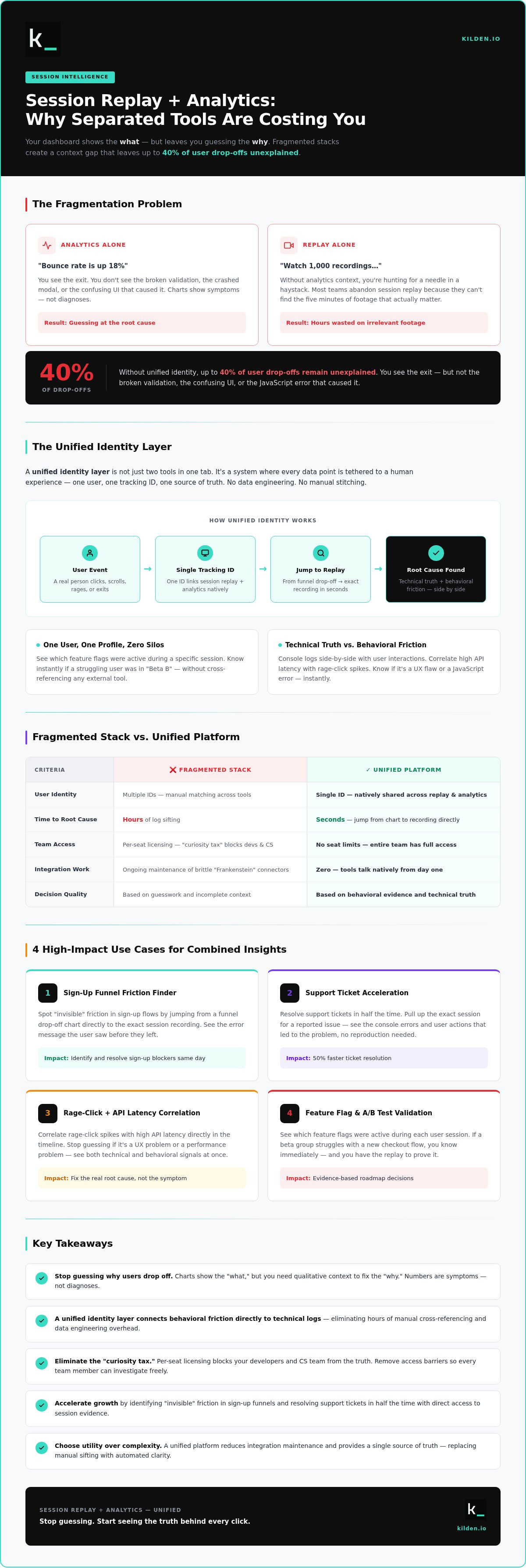
Data without sight is a guess. Sight without data is a waste of time. Most growth teams operate in a state of perpetual guessing. They see a chart dip and call a meeting. They watch a random video of a user clicking a button and call it research. This is fragmented thinking. In 2026, session replay and analytics must exist as a single unit. Separating them creates a context gap that leaves up to 40% of user drop-offs unexplained. You see the exit, but you don't see the broken validation or the confusing UI that caused it.
Relying on "Frankenstein stacks" is a silent killer of product velocity. When your analytics tool and your replay tool don't share a unified identity layer, your team wastes hours trying to match timestamps. You end up with data silos that slow down decision-making. A unified platform isn't just two tools in one tab; it's a system where every data point is tethered to a human experience. It turns abstract numbers into a coherent story of user behavior.
The Quantitative Trap: Why Charts Lie
A high bounce rate is a symptom, not a diagnosis. Your dashboard might show that users are leaving your pricing page at a record pace. Is the price too high? Is the "Buy Now" button broken on Safari? Numbers alone won't tell you. Metrics like "average time on page" are equally deceptive. A user spending five minutes on a checkout screen could be highly engaged, or they could be trapped in a loop of error messages. Making product decisions based on these incomplete data sets is just gambling with your roadmap. You need to see the friction to fix it.
The Qualitative Burden: Finding the Needle in the Replay Stack
Watching 1,000 replays is not a strategy; it's a chore. Most teams abandon session replay because they can't find the five minutes of footage that actually matter. This is where session replay and analytics integration becomes critical. Analytics filters should make your replays instantly searchable. Instead of hunting for bugs, you jump directly from a specific funnel drop-off to the exact recording of that event. You see the technical logs and the behavioral friction side by side. This transforms replay from a passive observation tool into an active troubleshooting engine. It's about finding the "why" in seconds, not hours.
- Stop treating users like rows in a spreadsheet.
- Connect every funnel exit to a visual truth.
- Eliminate the manual work of matching user IDs across tools.
The Unified Identity: Bridging the Quantitative-Qualitative Gap
Most product teams are flying blind. They use one tool for charts and another for video. These systems never share a user ID. It's a fragmented mess. You see a drop-off in your funnel, then spend twenty minutes trying to find the corresponding session recording. This is a waste of your technical intelligence. If your tools don't speak the same language, you're just guessing at the truth. You don't need more dashboards. You need a single source of truth.
The solution isn't more integrations. It's a unified identity layer. This eliminates the need for managed data engineering. Your tools should talk to each other natively from day one. This shift moves your team from simply tracking events to truly understanding human journeys. You stop looking at clicks and start looking at people. It's about seeing the person behind the data point.
One User, One Profile, Zero Silos
Stop chasing "anonymous" data gaps. When your tracking is unified, you see the whole human. You see exactly which feature flags were active during their specific session. This context is vital. If a user struggles with a new checkout flow, you need to know they were part of the "Beta B" test group instantly. Unified Identity is the prerequisite for product-led growth. By using a platform where session replay and analytics share a single tracking ID, you remove the friction of data silos. This is how you streamline your growth stack without the overhead of complex maintenance or manual data stitching.
Technical Truth vs. Behavioral Friction
Is it a UX flaw or a Javascript error? Usually, it's both. A unified profile lets you see console logs side-by-side with user interactions. You can tell instantly if a user stopped clicking because they were confused or because a script failed. This is the power of the "Z-axis" in product management. You correlate high API latency with a sudden spike in rage-clicks. You don't need to ask the user what happened. You already saw it. This level of transparency transforms how you prioritize your roadmap. You stop fixing what you think is broken and start fixing what you know is hurting the user experience. By combining session replay and analytics into one view, you bridge the gap between technical reality and human behavior. It turns every bug report into a clear, visual instruction for your engineering team.
Fragmented Stack vs. Unified Platform: A Buyer’s Comparison
The "Best-of-Breed" strategy is an expensive myth. Vendors tell you that picking five specialized tools is better than one unified platform. They don't tell you about the integration debt. Every tool you add requires its own SDK, its own maintenance, and its own data reconciliation. In 2026, managing a fragmented stack isn't just a technical burden; it's a strategic failure. When you separate your session replay and analytics, you're paying a premium to keep your data in silos.
Implementation time is the first casualty of tool sprawl. Installing five SDKs takes weeks of developer coordination. One SDK takes minutes. But the real cost appears months later. When Tool A updates its API, your custom integration breaks. When your analytics tool reports a different number of sessions than your replay tool, your "Source of Truth" vanishes. A unified platform eliminates this drift. It ensures that every team member looks at the same reality without the need for managed data engineering.
The Per-Seat Tax: Why It Limits Your Growth
Data-driven culture dies behind a login screen. Most legacy tools charge per-seat. This creates a "curiosity tax." If your support team or sales reps need to see a replay to understand a customer problem, you shouldn't have to check your budget first. Seat-based pricing forces teams to share passwords or gatekeep information. It keeps the truth in the hands of a few power users while everyone else operates on assumptions. It's an outdated model that prioritizes vendor revenue over your team's efficiency.
Kilden takes a different path by offering unlimited seats. We believe everyone should see the truth. Growth happens when a support agent can resolve a ticket in half the time because they saw exactly what the user saw. It happens when a marketer identifies a friction point without waiting for a data scientist to run a report. True data culture requires total access. You can't build a product-led company if half your team is locked out of the data.
Integration Debt: The Cost of Tool Sprawl
Multiple tracking scripts kill page performance. Every SDK you add increases latency. In a world where a 100ms delay can drop conversions, bloated tracking is self-defeating. You're literally slowing down your site to measure how slow it is. A unified platform uses a single, lightweight script to handle everything from feature flags to session replay and analytics. This reduces the technical load on your frontend and ensures a smoother experience for your users.
Then there's the reporting gap. Different tools use different definitions for sessions, bounces, and active users. You spend your weekly sync arguing about which tool is right instead of fixing your product. A single dashboard for the entire product lifecycle ends the debate. You get one number, one user profile, and one clear path to growth. It’s the relief of knowing that what you see in your charts matches what you see in your replays.
4 High-Impact Use Cases for Combined Insights
Insight is the baseline. Action is the goal. In 2026, knowing a user left your platform isn't enough. You need to know why they left and exactly how to stop the next one from following them. By integrating session replay and analytics, you bridge the gap between abstract data and human empathy. It's about moving from "we have a problem" to "we have a fix" in minutes. Your team doesn't have time for theory. They need utility.
- Funnel Optimization: Identify "invisible" friction points that charts don't capture.
- Customer Support: Resolve tickets in half the time by seeing exactly what the user saw.
- Product Launches: Use feature flags and replays to validate new UI changes in real-time.
- User Feedback: Trigger targeted surveys based on specific recorded behaviors rather than random timers.
Fixing the Leaky Sign-Up Funnel
Identify the drop-off step in your analytics dashboard first. This is your starting point. Instead of guessing why users vanish at step three, click through to the replays for that specific cohort. This is where the truth lives. Observe the interaction. Is it a confusing form field that lacks clear instructions? Or is it a technical validation error that only triggers on mobile devices? When you see the struggle, the solution becomes obvious. You stop debating and start shipping. This workflow replaces hours of meetings with seconds of observation.
Closing the Loop with In-App Engagement
Observation is only half the battle. Once you find the friction, you must act. If your replays show users struggling with a complex new feature, don't wait for a sprint cycle to redesign it. Deploy a Product Tour or a Messenger prompt immediately to guide them through. You can use In-App Banners to warn users about known technical hurdles while your developers work on a permanent fix. This turns a session replay from a post-mortem tool into a data-driven hypothesis for an A/B test. You aren't just watching users; you're actively helping them succeed. Start seeing the truth and taking action today with Kilden's unified growth platform.
Every recorded session is a lesson in user behavior. When you correlate these videos with your core metrics, you build a "Z-axis" of product management. You see the technical logs, the behavioral rage-clicks, and the eventual conversion or exit. This level of clarity is the only real competitive advantage left in a crowded market. It allows you to build a product that isn't just functional, but human-centric and resilient.
Kilden: The No-Nonsense Choice for Growing SaaS Teams
Growth shouldn't be a puzzle. Most SaaS teams spend more time managing tools than building products. Kilden exists because we're tired of the "best-of-breed" lie. We didn't just bolt separate tools together. We built a unified engine from the ground up. By combining session replay and analytics with a full engagement suite, we give you the "what," the "why," and the "how to fix it" in one place. It's about utility, not marketing jargon.
Getting started is fast. You don't need a month of managed data engineering. You need one SDK and a few minutes. From that point on, your data is whole. You stop jumping between tabs. You start seeing the human journey behind the numbers. This is how you reclaim your time and your technical focus. We focus on the Z-axis of product management, seeing the human behind the data point.
Beyond Analytics: The Engagement Suite
Insights are useless if you can't act on them. Kilden includes a native Messenger and In-App Messaging suite. You see a user struggling in a replay; you talk to them right where they are. You don't wait for an email. You intervene. Our no-code Product Tours let you fix onboarding friction without opening a dev sprint. If the data shows users are getting lost, build a guide in minutes. We also include Feature Flags as a core part of the stack. You can test, learn, and roll back with total confidence. If a new UI causes rage-clicks, you kill it instantly. This isn't just observability; it's active control. You can also deploy in-app banners and surveys to gather feedback exactly when it matters most.
The Kilden Promise: Transparency and Fairness
We hate the "curiosity tax." Most platforms punish your growth with per-seat licensing. We don't. Kilden offers unlimited seats. Period. We want your entire team to see the truth. Support agents, sales reps, and developers should all have access to the same behavioral evidence. It's the only way to build a true data culture. Our platform respects your technical intelligence. We provide a lean, minimalist architecture that mirrors the efficiency of your own software. No bloat. No fluff. Just the truth. By integrating session replay and analytics natively, we ensure your team spends less time debugging data and more time building features users love.
The status quo of fragmented, expensive ecosystems is over. You deserve a tool that works as hard as you do. It's time to bridge the context gap and start building for humans again. Stop guessing and start seeing with Kilden.
The Future of Product Growth is Contextual
The days of guessing why users drop off are over. Fragmented data silos and expensive per-seat licensing kill product velocity. In 2026, winners will be the teams that bridge the gap between technical reality and human behavior. By unifying session replay and analytics, you turn raw numbers into actionable truths. You stop fixing symptoms. You start solving root causes. It's about moving from "what happened" to "how we fix it" in seconds. This isn't just a technical upgrade. It's a strategic necessity for any team that values efficiency over complexity.
Kilden provides everything you need without the corporate fluff. You get a unified analytics and engagement suite. No managed data engineering required. We believe in transparency and fairness. That's why we offer no per-seat licensing. This ensures your whole team has the clarity they need to move fast and build better products. Stop sifting through noise. Start seeing the human behind every data point. Start your unified product journey with Kilden today. You have the technical intelligence. now get the tools that respect it and empower your team to win.
Frequently Asked Questions
What is the difference between session replay and standard product analytics?
Standard analytics tell you what happened through charts and numbers. Session replay shows you why it happened by recreating the user's actual experience. If your dashboard shows a funnel drop-off, analytics pinpoint the step, but replay reveals the confusing UI or broken button causing the exit. Combining session replay and analytics gives you the full story.
Does session replay software slow down my website or application performance?
Kilden uses a lightweight script designed for high-velocity applications. It doesn't record a heavy video file; it captures DOM changes and events. This method ensures minimal impact on page load times and execution speed. You get high-fidelity insights without the performance tax associated with legacy recording tools. Visibility shouldn't come at the cost of user experience.
How does Kilden handle user privacy and sensitive data in recordings?
We use automatic masking to protect sensitive information. Passwords and credit card fields are never captured. You can also define specific elements or CSS classes to be excluded from recordings. Data security is a core feature, not a bolt-on. We ensure you see the behavioral truth without compromising user trust or technical safety.
Can I use session replay to debug technical errors and Javascript crashes?
You can see technical logs side-by-side with user interactions. When a script fails or a Javascript error occurs, it's recorded alongside the visual session. This allows your developers to replicate bugs instantly without asking users for screenshots. You see the exact state of the browser at the moment of failure. It turns debugging into a linear process.
Why should I avoid per-seat licensing for my analytics and replay tools?
Per-seat licensing is a curiosity tax that limits your team's potential. It forces people to share logins or gatekeep data, which leads to fragmented decision-making. We offer unlimited seats because everyone in your company deserves access to the truth. Support, sales, and product teams work better when they aren't locked out of the data by budget constraints.
How long does it take to integrate a unified analytics and replay platform?
You can be up and running in minutes. Integration requires a single SDK installation with no managed data engineering required. Once the script is live, it begins capturing sessions and events automatically. You don't have to wait weeks for a complex setup. You get a single source of truth for your entire product lifecycle from the start.
Can I trigger in-app messages based on what I see in a session replay?
You can turn observations into action immediately. If session replay and analytics reveal a common friction point, you can deploy a Messenger prompt or a Product Tour to guide users. This closes the loop between seeing a problem and fixing it. You aren't just watching users struggle; you're actively helping them succeed with targeted engagement tools.
Is session replay compliant with GDPR and other privacy regulations?
Kilden is built to comply with GDPR, CCPA, and other global privacy standards. We provide built-in tools for data masking, consent management, and user data deletion. Our platform respects the legal requirements of data collection while still providing the qualitative context you need to grow. We prioritize transparency and fairness in every byte of data we handle.