Stop Paying the Tool Tax: Why You Should Replace Multiple Product Tools with One Platform

on this page ▾
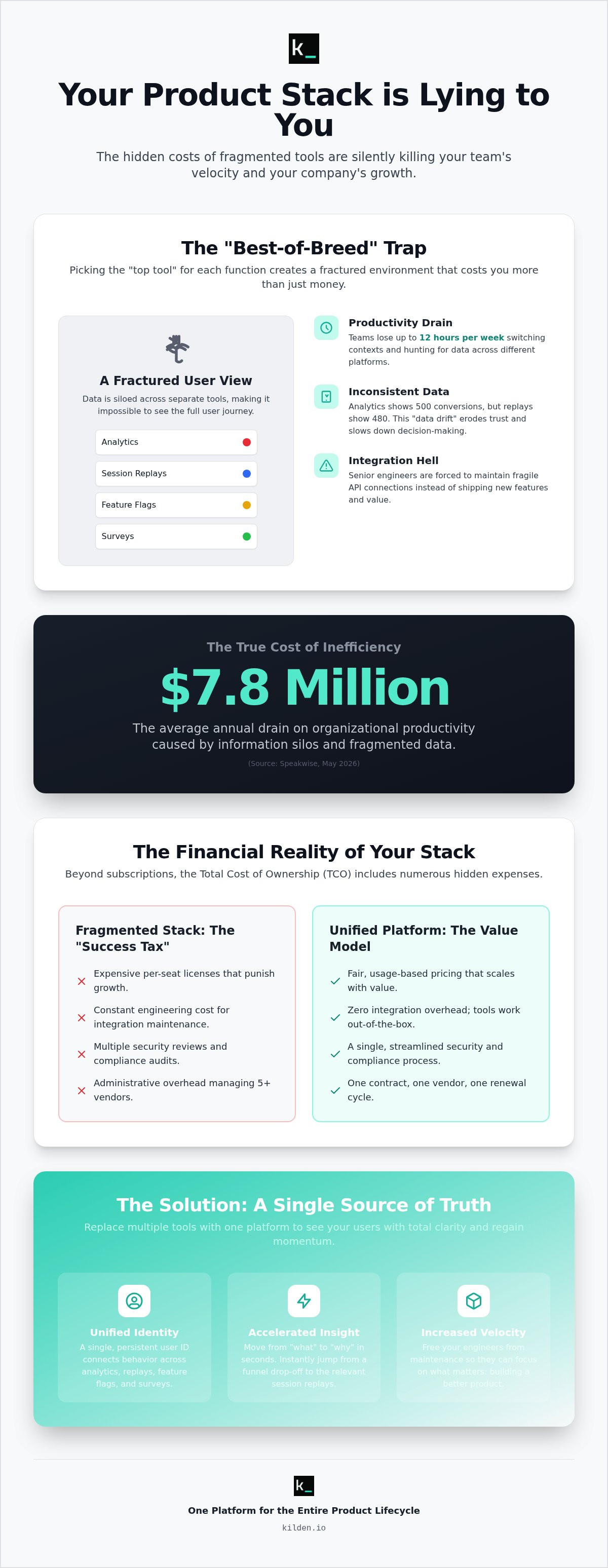
Your product stack is lying to you. Every time you context switch between an analytics dashboard and a session replay tool, you lose the thread of the user journey. You are paying a tool tax that costs your team up to 12 hours of productivity every single week. It is a structural failure that forces your engineers into integration maintenance hell instead of feature development. To stop the bleeding, you need to replace multiple product tools with one platform. Fragmented data is not just an inconvenience; it is a $7.8 million drain on organizational productivity according to recent industry data.
You already know the frustration of seeing inconsistent user data across three different browser tabs. You are likely tired of astronomical per-seat licensing fees that punish your team for growing. This guide will show you how to eliminate data silos, slash your subscription costs, and regain your product velocity. We will break down the logic of consolidating your stack into a single source of truth. You will learn how a unified approach leads to a lower total cost of ownership and a significantly faster time-to-insight for every feature you launch.
Key Takeaways
- Understand how the best-of-breed approach creates a context switching tax that drains your team's focus and budget.
- Discover how to replace multiple product tools one platform to eliminate data silos and create a unified source of truth for user behavior.
- Identify the hidden fiscal leaks in your current stack by auditing ghost subscriptions and overlapping feature sets.
- Accelerate your time-to-insight by connecting analytics, session replays, and feature flags in a single, high-velocity workflow.
- Stop paying for seats you don't use and remove the overhead of managed data engineering through usage-based, integrated tooling.
Table of Contents
- The Hidden Cost of the Best-of-Breed Product Stack
- Why Data Silos Kill Product Growth
- Evaluating All-in-One vs. Fragmented Tooling
- How to Transition to a Unified Product Platform
- Kilden: One Platform for the Entire Product Lifecycle
The Hidden Cost of the Best-of-Breed Product Stack
The "best-of-breed" philosophy is a structural lie. It sounds logical to pick the top tool for every specific function. In practice, it creates a fractured environment where no one has a clear view of the user. You are paying a hidden tax in productivity, data integrity, and cold hard cash. When you choose to replace multiple product tools one platform, you aren't just simplifying your stack; you are reclaiming your team's ability to actually build. Fragmented data is a $7.8 million drain on organizational productivity according to May 2026 data from Speakwise.
Fragmented stacks rely on fragile integration layers. These are the silent killers of engineering velocity. Your senior developers spend their sprints maintaining API connections and debugging webhook failures instead of shipping value. This fragmentation is why many modern organizations are moving toward integrated environments, similar to how Enterprise resource planning (ERP) systems consolidated business operations decades ago. You cannot scale if your foundation is made of duct-taped subscriptions.
The Cognitive Load of Fragmented Tooling
Product Managers are currently losing roughly 30% of their week to "data hunting." They spend hours toggling between analytics, session replays, and feature flags just to verify a single hypothesis. This constant context switching destroys deep work. It takes significant time to regain focus after a distraction. When your data lives in five different places, you are never truly focused. You are just managing tabs.
Then there is the issue of "Data Drifting." Your analytics tool reports 500 conversions, but your session replay tool only shows 480. Which one is the truth? This inconsistency erodes trust across the organization. Decisions slow down because the team spends more time debating the validity of data than acting on it. In high-growth environments, this delay is a competitive disadvantage that you cannot afford.
The Financial Reality of Per-Seat Licensing in 2026
The traditional SaaS model uses per-seat licensing as a "success tax." As your team expands, your software costs scale exponentially. This creates a perverse incentive to limit tool access. It effectively recreates the very silos you are trying to break. You shouldn't have to choose which team members get to see user behavior based on your budget constraints. It's a backwards way to run a modern product team.
Beyond the monthly subscription, the Total Cost of Ownership (TCO) for a fragmented stack includes several invisible hurdles. Every new vendor requires a separate security review and compliance audit. Managing five different contracts and renewal cycles is a full-time administrative burden for your procurement team. You also face the overhead of data engineering, where you pay experts just to force disconnected tools to speak the same language. Consolidating into one platform removes these hurdles and allows you to pay for usage and value rather than headcount.
Why Data Silos Kill Product Growth
Data silos are not just a technical inconvenience. They are a fundamental barrier to growth. When your analytics tool and your messaging tool see two different users, your product has an identity crisis. This fragmentation creates a massive blind spot where you see the "what" but never the "why." You might see a drop-off in a specific funnel; however, without integrated session replays, you are just guessing at the cause. You must replace multiple product tools one platform to eliminate these gaps and see your users with total clarity.
Information silos cost organizations $7.8 million annually in lost productivity according to Speakwise (May 2026). For product teams, the cost is even higher in terms of missed opportunities. If your tools don't talk to each other, your product-led growth (PLG) strategy is dead on arrival. You cannot build a seamless user journey when your data is trapped in separate, disconnected dashboards. It is impossible to guide a user through a value realization moment if you don't know exactly where they are in real-time. Fragmentation is a choice to stay blind.
Unified Identity: The Single Source of Truth
Manual data mapping is a relic of the past. If your team is still "stitching" user IDs between different specialized tools, you are wasting valuable engineering hours. A single user ID across feature flags, session replays, and surveys is non-negotiable for modern teams. Without it, your data is just noise. Unified Identity is the persistent, shared data record that connects a single user across every touchpoint of the product lifecycle. This clarity allows you to move from vague segments to precise, individualized engagement that actually converts.
Real-Time Response vs. Batch Processing
Reacting to user behavior 24 hours late is the same as not reacting at all. Most fragmented stacks rely on batch processing or slow API syncs. This delay prevents real-time engagement. If a user is struggling with a new feature, they need help right now. They don't need an email tomorrow morning. A unified platform allows you to trigger product tours based on live session replay triggers. This "Instant Context" is what separates high-velocity teams from the rest of the pack. It allows customer support to see exactly what the user saw, at the exact moment they saw it, without asking for screenshots. This is the level of efficiency required for 2026 scale.
Evaluating All-in-One vs. Fragmented Tooling
The "master of none" argument is a relic of the early SaaS era. Critics used to claim that integrated platforms were wide but shallow. That is no longer the reality. Modern engineering allows for deep, specialized functionality built on a single, high-performance data layer. Choosing to replace multiple product tools one platform is a strategic pivot toward depth, not a compromise on quality. You are trading the friction of data translation for the power of instant, cross-functional insights.
Feature parity is a vanity metric. What actually drives a Product Manager's daily output is workflow efficiency. A specialized tool might have three extra niche features, but if it takes twenty minutes to sync that data with your feature flags, those features are a net loss. You need a stack that moves at the speed of your thought process. Consolidation provides one SLA, one security audit, and one relationship to manage. It removes the administrative bloat that kills momentum in high-growth companies.
Scalability is the final hurdle. As you look toward 2026 traffic volumes, your stack must handle billions of events without breaking. Fragmented systems fail at scale because the connections between them are the weakest points. A unified platform is designed for this pressure. It processes analytics, replays, and messaging through a single pipeline, ensuring your infrastructure remains lean as your user base grows.
When to Consolidate Your Stack
You have likely hit the "Integration Ceiling." This happens when your tools stop talking to each other and your team starts manually exporting CSVs just to get a clear picture of a feature launch. If your engineering team spends more than 5% of their time on "data plumbing," you have outgrown your fragmented toolset. The cost of fragmentation is now higher than the perceived risk of vendor lock-in. It's time to simplify.
- Data Drifting: Numbers in your analytics dashboard don't match your session replay counts.
- Subscription Bloat: You are paying for three different tools that all offer "in-app messaging."
- Access Barriers: Non-technical team members can't get answers because the data is trapped in a complex, specialized tool.
The 'Efficiency Frontier' of Product Management
Consolidation changes who can use data. In a 5-tool stack, only the "power users" know where to find specific insights. A unified platform democratizes access. When analytics, replays, and flags live in one UI, your designers and support leads can self-serve. This transparency slashes the internal "request-and-wait" cycle that bogs down most organizations. It also reduces technical debt. Fewer SDKs in your codebase means a lighter app and a faster experience for your users. You aren't just saving money; you are increasing your total engineering velocity.
How to Transition to a Unified Product Platform
Moving to a consolidated stack is a strategic reset. It is not just about deleting apps. It is about reclaiming your data integrity. To successfully replace multiple product tools one platform, you must start with a ruthless audit. Identify every overlapping feature. You are likely paying for three different versions of session replay across your specialized tools. Hunt down ghost subscriptions. These are the forgotten licenses that drain your budget without providing a single insight. Consolidating these allows you to reinvest that capital into actual product development.
Historical data matters. However, you don't need to migrate every junk event from the last five years. Focus on your data heritage. Identify the core metrics that actually drive your business outcomes. Map these historical insights carefully. Use this transition to clean your schema. It is an opportunity to move away from "Managed Data Engineering" overhead and toward a system that just works. If you are ready to start this process, you can explore the Kilden platform today.
The 30-Day Migration Blueprint
A month is enough time to flip the switch if you are disciplined. Follow this sequence to maintain momentum.
- Step 1: Metric Inventory. Separate your "Must-Have" metrics from the "Nice-to-Have" clutter. If a metric hasn't influenced a decision in six months, leave it behind.
- Step 2: Schema Mapping. Align your existing event names with your new unified platform. This ensures your funnels and cohorts remain consistent post-migration.
- Step 3: Identity Framework. Implement your unified identity logic first. This is the foundation that connects your analytics, feature flags, and messaging into a single source of truth.
Avoiding Common Migration Pitfalls
Data gaps are the biggest risk during a transition. If you pull the plug on your old tools too early, you lose visibility. Manage your stakeholder expectations early. Marketing needs to know their campaigns won't break. Engineering needs to know the SDK won't bloat the app. Product needs to know the dashboards will be ready on day one. Be transparent about the timeline. Running your old and new systems in tandem for a two-week parallel run period ensures data integrity before you finalize the migration. This overlap acts as a safety net. It allows you to verify that your new analytics match your legacy benchmarks before you stop paying the tool tax.
Kilden: One Platform for the Entire Product Lifecycle
Kilden is the logical conclusion of a mature product stack. It is the platform that finally allows you to replace multiple product tools one platform without sacrificing depth. We didn't build just another dashboard. We built a unified environment. Product analytics, session replay, and feature flags coexist in a single UI. This integration removes the friction of moving between tabs. It allows you to see the "what" and the "why" simultaneously. You see the impact of a deployment immediately. There is no waiting for a data sync. There is no doubt about the truth.
The Kilden Engagement Suite takes this a step further. Most teams use one tool for surveys and another for tours. This fragmentation causes the identity crisis we explored earlier. Kilden combines Messenger, in-app messaging, and product tours into a single system. You can trigger a survey the moment a user encounters a specific feature flag. You can launch a tour based on a live session replay trigger. This is engagement at scale. It is driven by real-time context, not stale data from a batch process that ran yesterday.
The Kilden Engagement Suite
Integrated in-app surveys allow you to collect feedback when it is most relevant. You don't need to send a follow-up email three days later. You ask the question while the user is still in the flow. By combining feature flags with analytics, you see the direct impact of every deployment on your core business metrics. It is a linear view of progress. Product tours built on this data actually convert. They are personalized to the user's actual behavior. They don't rely on vague segments or outdated benchmarks. They rely on the reality of the user journey.
Why Kilden is the Logical Choice for Growth Teams
We have eliminated the need for managed data engineering. You shouldn't have to hire a specialist just to make your tools talk to each other. That is a waste of technical talent. Kilden is designed for 2026 scale. It handles the complexity of the next decade of SaaS without the bloat. Our approach is grounded in technical utility and price transparency. We strip away the corporate fluff. We focus on results. We prioritize the humans behind the data and the humans using the software.
We don't believe in the per-seat licensing model. It is a success tax that punishes your growth. It creates artificial silos where only a few people have access to the truth. Instead, Kilden uses a usage-based model. This empowers your entire organization to be data-driven. Designers, developers, and support leads all get access to the same UI. There are no barriers to entry. Currently, Kilden is in an early access phase and is free of charge. We will provide at least 30 days' notice before introducing paid plans. This is the no-nonsense approach your team deserves. It is time to stop paying the tool tax and start shipping with clarity.
Ready to simplify? See how Kilden replaces your fragmented stack.
Reclaim Your Product Velocity
The era of "best-of-breed" fragmentation is ending. You have seen how data silos drain millions in productivity and how context switching kills deep work. It is time to stop managing a dozen different SDKs and start focusing on your users. When you replace multiple product tools one platform, you eliminate the success tax of per-seat licensing and the nightmare of manual data mapping. You gain a single source of truth that actually scales for the next decade of SaaS growth.
Kilden provides the integrated analytics, session replays, and feature flags required for 2026 scale. It is a logical shift toward technical unity and fiscal clarity. You don't need more specialized tools; you need better integration and lower overhead. Currently, Kilden is in early access and free to use. It is the no-nonsense solution for teams tired of fragmented workflows and astronomical licensing fees.
Stop the tool sprawl-Get a demo of Kilden's unified platform
Simplify your stack. Empower your team with better data. Reclaim your time and build something great.
Frequently Asked Questions
Is an all-in-one platform really as powerful as specialized point solutions?
Yes. Modern unified platforms match the technical depth of specialized tools while removing the friction of data silos. Kilden provides high-performance product analytics and session replay built on a single data layer. You don't lose power; you lose the latency of cross-tool data translation. When you choose to replace multiple product tools one platform, you gain a unified view that disconnected point solutions cannot replicate.
How much can I realistically save by replacing multiple product tools?
You save on direct subscription costs and the hidden tax of engineering time. Fragmented stacks often force you to pay for overlapping features across several different vendors. By consolidating, you eliminate the "success tax" of per-seat licensing and the need for expensive data engineering to stitch systems together. Your total cost of ownership drops as your administrative and technical overhead disappears.
What happens to my historical data when I switch to a unified platform?
You should move the core metrics that drive actual business outcomes. We recommend a phased migration where you map your essential event schemas to the new platform first. A two-week parallel run ensures data integrity before you decommission legacy systems. This approach allows you to maintain your data heritage without carrying over years of technical debt or junk events.
Does Kilden offer feature parity with dedicated feature flag managers?
Kilden offers robust feature flags built directly into your analytics workflow. Unlike dedicated point solutions, our flags are natively connected to your user behavior data. This means you can see the immediate impact of a deployment on your conversion funnels without manual tagging. You get the same control as specialized managers with significantly more context and faster time-to-insight for every release.
How long does it take to migrate from a 5-tool stack to Kilden?
A typical migration follows a structured timeline focused on data integrity. This includes auditing your current stack and mapping your event schema. The process is streamlined because you are moving to a platform designed for 2026 scale. Most teams find they can replace multiple product tools one platform in a single sprint once the core data mapping and identity logic are finalized.
Can I still integrate Kilden with my existing data warehouse or CRM?
Yes. Kilden acts as your primary source of truth for product behavior but integrates with your broader business stack. You can push unified insights to your data warehouse or CRM to keep sales and marketing teams aligned. We provide the technical agility to ensure your product data remains accessible across the entire organization without the need for fragile, custom-built connectors.
Does Kilden require a dedicated data engineer to maintain?
No. Kilden is built to remove the requirement for managed data engineering. The platform handles the data plumbing and identity stitching automatically. This frees up your senior engineers to focus on building features instead of maintaining API connections. It is a self-serve environment designed for product managers and designers to access insights instantly without a technical intermediary.
How does the 'no per-seat' pricing model actually work for large teams?
Our model focuses on usage rather than headcount. We believe that every team member should have access to user insights without increasing your software bill. Kilden is currently in early access and free of charge. We will notify users at least 30 days before any paid features are implemented. This ensures your growth is never punished by per-seat licensing fees or hidden costs.