The 2026 Guide to Selecting a Feature Flag Management Platform

on this page ▾
Most feature flag platforms are just expensive light switches that charge you for the privilege of flicking them. Your engineering team is likely paying a "success tax" every time you hire a new developer, even if they rarely touch the dashboard. Beyond the cost, your flags often live in a silo, disconnected from the product analytics that tell you if a feature actually works. Choosing the right feature flag management platform in 2026 requires a shift in perspective. It's no longer about just toggling code. It's about closing the loop between deployment and real-world impact without the bloat of legacy pricing.
You already know that decoupling deployment from release is the only way to move fast without breaking things. But you shouldn't have to deal with slow SDKs that tank your app performance or data gaps that leave you guessing about user behavior. This guide will show you how to select a platform that eliminates these silos and scales with your usage, not your headcount. We'll break down the technical benchmarks, governance standards, and pricing models you need to look for to ensure your flags empower your team instead of slowing them down.
Key Takeaways
- Stop paying "per-seat taxes" that penalize growth. Choose a pricing model that scales with your usage, not your team's headcount.
- Prioritize millisecond latency. Your feature flag management platform should empower your release cycle, not create a performance bottleneck for your users.
- Eliminate data silos. Connect your flags directly to product analytics and session replays to verify the real-world impact of every new feature.
- Control technical debt. Implement quarterly cleanup sprints and standardized naming conventions to keep your codebase lean and manageable.
- Think beyond the toggle. Move toward unified platforms that combine flags, analytics, and in-app engagement into a single, cohesive workflow.
Table of Contents
- The Hidden Cost of Fragmented Feature Flag Management
- The 2026 Buying Framework: What to Look for in a Platform
- Point Solutions vs. Unified Growth Platforms
- Best Practices for Modern Feature Rollout Management
- Kilden: The All-in-One Alternative to Bloated Flag Tools
The Hidden Cost of Fragmented Feature Flag Management
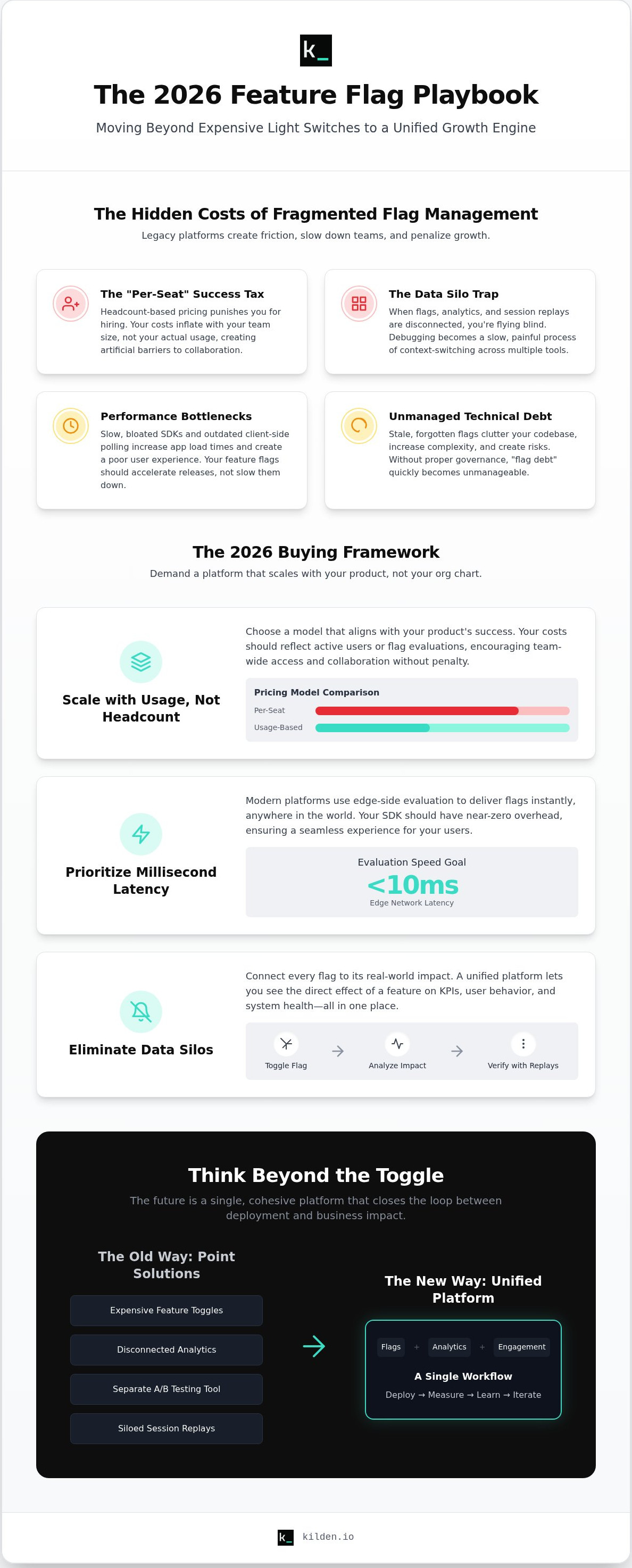
Modern software teams are drowning in a "tool tax." It's the hidden cost of maintaining a dozen disconnected platforms that refuse to talk to each other. You have one tool for deployment, another for analytics, and a third for session replays. When these systems live in isolation, your feature flag management platform becomes nothing more than a collection of expensive light switches. Toggling a feature in a vacuum is dangerous. It's a binary choice made without the context of user behavior or system health.
If your Product Managers can't see the immediate impact of a flag, that flag is failing. Engineering might have "shipped" the code, but the business hasn't actually "released" the value. This fragmentation creates a massive cognitive load. Developers spend more time context-switching between dashboards than they do writing code. True efficiency happens when the toggle and the data live in the same house.
The Data Silo Trap
Debugging a failed rollout shouldn't require three different browser tabs. When a new feature causes a spike in latency or a drop in conversion, you need to know why instantly. The friction between engineering toggles and product analytics is where bugs thrive. "Dormant code" sitting behind a flag still needs active monitoring. If you can't see a Session Replay of the exact moment a flagged feature failed, you're just guessing. You need a unified identity that follows the user from the flag to the final click.
Why Per-Seat Licensing Kills Velocity
Headcount-based pricing treats your growing team as a liability. It's the "Developer Tax." Every time you hire a new engineer or bring on a fresh PM, your software bill spikes. This model creates a perverse incentive to limit access to your most critical tools. We've all seen it: teams sharing a single "admin" login to save on costs, which destroys audit trails and security.
- Artificial Barriers: Pricing should encourage collaboration, not restrict it.
- Scaling Friction: Your costs should reflect your product's success, not your HR department's hiring pace.
- The Kilden Difference: We believe software should scale with your usage. Everyone on your team deserves access to the truth without a per-seat penalty.
When you gate-keep your feature flag management platform behind seat-based tiers, you're choosing budget over speed. High-velocity teams need everyone looking at the same data at the same time. Anything less is just organized chaos.
The 2026 Buying Framework: What to Look for in a Platform
Selecting a feature flag management platform shouldn't be a guessing game. Most teams get distracted by shiny dashboards and ignore the underlying plumbing. In 2026, the gap between a legacy tool and a modern platform is measured in milliseconds and data integrity. You aren't just buying a toggle. You're buying the ability to move fast without the fear of a total system meltdown. If your framework doesn't prioritize performance and unified data, you're just trading one technical debt for another.
Your checklist must move beyond basic "on/off" functionality. High-velocity teams require targeting granularity that allows for complex user segments based on real-time behavior. You need to know that a flag flipped for a specific user segment actually moved the needle on your core metrics. This requires a unified identity. You must be able to track a user journey from the moment a flag is toggled all the way through to a session replay. If you want to see how these pieces fit together without the typical integration headache, you can explore a unified approach to flags and analytics.
Technical Performance and SDK Reliability
Latency is the only metric that matters. Edge-side evaluation has become the standard, replacing outdated client-side polling that drains batteries and increases load times. SDK overhead is the primary killer of mobile UX, turning a simple feature toggle into a performance bottleneck. Your platform should also help you manage "flag debt." Look for tools that automatically identify stale code and prompt your team to remove flags once a rollout is 100% complete. Clean code is fast code.
Beyond Toggles: Experimentation and Governance
Can your flag tool handle a statistically significant A/B test? If it can't connect flags to business KPIs like revenue, retention, or churn, it's not an experimentation tool. It's just a remote config file. Governance is equally critical. You need granular RBAC (Role-Based Access Control) to maintain safety without slowing down the sprint. Control shouldn't be a bottleneck.
- Audit Trails: You must know exactly who flipped the switch, when they did it, and why.
- Automated Rollbacks: When "safe" isn't enough, you need "self-healing" systems that automatically kill a feature if error rates spike.
- Predictable Scaling: Ensure your governance model doesn't break when you add your 50th or 500th developer.
Effective governance means empowering your team to take risks safely. It's the difference between a high-performance engine and a car without brakes. Choose the platform that provides the guardrails so your engineers can finally stop hesitating and start shipping.
Point Solutions vs. Unified Growth Platforms
The industry has sold us a lie. It's called "Best of Breed." The logic suggests that buying five specialized, disconnected tools will create a superior technical stack. In practice, it creates a fragmented mess. A standalone feature flag management platform provides the toggle, but it leaves you blind to the outcome. Five great tools don't make a great platform. They just make five separate invoices and five different versions of the truth.
Context is the difference between a bug and a feature. When your flags live in the same house as your analytics, you gain the power of "Contextual Engagement." Imagine triggering an in-app banner specifically for the 10% of users experiencing a new beta checkout. Kilden combines analytics and flags to provide a single source of truth. You stop guessing and start seeing the wholeness of the user journey. You move from managing code to managing outcomes.
The Problem with Manual Data Reconciliation
Exporting CSVs from a flag tool to import them into an analytics suite is a 2015 workflow. It's slow. It's prone to human error. Worst of all, it leads to "Dirty Data" when different tools use conflicting user identifiers. You can't reconcile a rollout's impact if your systems don't agree on who the user is. Your session replays must be aware of your active feature flags. If a user hits a wall, you need to see exactly which flags were enabled for them at that precise millisecond. Anything less is just guesswork.
Why Product Managers Need More Than a Switch
Product Managers need to see the "Why" behind the "What." A toggle tells you the code is active. Analytics tell you if it's being clicked. But to truly close the feedback loop, you need integrated in-app surveys. When your feature flag management platform is unified with your engagement tools, a PM can trigger a survey specifically for the segment seeing a flagged feature. They get raw, human feedback instantly.
This shift empowers non-technical stakeholders to manage rollouts safely. They no longer have to wait for an engineering briefing to understand if a release is succeeding. They can see the truth for themselves. By removing the friction between "shipping" and "learning," you allow your team to iterate at a velocity that point solutions simply can't support.
Best Practices for Modern Feature Rollout Management
Shipping code is not the same as releasing a feature. Many teams treat their feature flag management platform as a simple dumping ground for every experimental toggle. This lack of discipline leads to a codebase cluttered with "zombie flags" and logic that no one understands. To maintain velocity, you must treat your rollout process with the same rigor as your production infrastructure. Logic belongs in the code, but control belongs in a standardized framework.
Start with naming conventions. If your flags are named "test_1" or "new_button_final," you've already lost. Standardize your labels across the entire organization using a [team]_[feature]_[type] format. This ensures that a PM in marketing and an engineer in DevOps both understand exactly what a toggle does without digging through documentation. Beyond naming, you must commit to hygiene. Implement a "Flag Cleanup" sprint every quarter. Technical debt is a silent killer. If a feature is at 100% and stable, the flag must die.
- Internal Dogfooding: Never release to 100% of your audience without an internal phase. Your own team should be the first to find the edge cases.
- Guardrail Metrics: Connect every flag to a specific technical threshold. If a new UI component causes a spike in latency, the system should know before your users do.
- Ownership: Assign every flag an owner and an expiration date. Toggles should be temporary, not permanent fixtures of your architecture.
Adopting Trunk-Based Development Safely
Trunk-based development is the foundation of high-velocity teams, requiring developers to merge small, frequent updates to a single branch. This approach eliminates "merge hell" but increases the risk of breaking production. Feature flags solve this by enabling continuous integration without broken builds. You can employ a "Dark Launch" strategy, where you deploy backend code to production without revealing the UI. This allows you to test system load and data integrity in the real world before the first user ever clicks a button.
Automated Rollbacks and Guardrail Metrics
Monitoring a dashboard manually is a recipe for burnout. You need automated rollbacks. Define your thresholds clearly. If a flagged feature causes error rates to climb above 1%, the platform should kill the feature instantly. Real-time session monitoring is essential here for identifying "silent failures" that don't trigger traditional server errors but ruin the user experience. If a rollback occurs, use in-app banners to communicate transparently with your users. Tell them you're optimizing the experience and will be back shortly. This builds trust rather than frustration.
Ready to move beyond simple toggles and start managing outcomes? Get started with Kilden’s unified feature flag and analytics platform to ship with total confidence.
Kilden: The All-in-One Alternative to Bloated Flag Tools
Kilden is the response to a market that overcomplicates simple needs. Most options for a feature flag management platform are built to maximize their own revenue through seat-based taxes. We built Kilden to maximize your shipping velocity. It's a muscular package that combines feature flags, product analytics, and session replays into a single, high-performance SDK. You don't need a sprawling stack of ten tools to understand your users. You need one source of truth that works.
Our model is built on transparency. We've eliminated per-seat licensing because headcount-based pricing is a relic of legacy enterprise software. It actively punishes you for growing your team. With Kilden, you get a no-seat licensing model that empowers everyone from your junior devs to your C-suite to access the data they need. You pay for what you use. You stay for the clarity. It's a straightforward approach that respects your budget and your intelligence.
Unified Identity: Connecting Flags to Human Behavior
Stop guessing why a feature is underperforming. When your flags and analytics live in separate silos, you're looking at half the picture. Kilden provides a unified identity across your entire growth stack. This means you can see the session replay of the exact user who triggered a flag error. You can observe the friction, identify the bug, and fix it in one continuous motion. By using a single SDK, you also eliminate the performance bloat that usually comes with stacking multiple tracking scripts.
- Contextual Engagement: Trigger product tours or in-app surveys based on specific flag states.
- Real-time Feedback: Use in-app banners to communicate with users the moment a rollout hits a snag.
- Wholeness: See the human behavior behind the technical toggle.
Scaling Without the Growth Tax
High-growth teams shouldn't have to choose between adding talent and keeping their software costs under control. Kilden supports early-stage startups and massive enterprises alike by focusing on usage rather than headcount. We've also eliminated the "Managed Data Engineering" headache. You shouldn't have to build complex pipelines just to see if a new feature moved your retention numbers. Kilden does the heavy lifting, allowing your engineers to focus on building rather than data plumbing.
The status quo of fragmented, expensive tools is over. It's time for a platform that prioritizes utility over marketing jargon and fairness over bloated contracts. Stop paying for seats. Start paying for growth. Try Kilden today.
Ship Faster Without the Success Tax
Selecting a feature flag management platform is a decision that defines your engineering culture. You can choose the status quo of fragmented silos and seat-based taxes. Or, you can choose a unified reality where every toggle is backed by real-world analytics and session replays. High-velocity teams don't have time for manual data reconciliation or tools that refuse to talk to each other. You need a single SDK that handles the technical plumbing so you can focus on the product.
Legacy systems treat your growing headcount as a liability. We believe growth should be celebrated, not taxed. It's time to build a workflow where product managers and engineers see the same truth in one muscular dashboard. Replace your fragmented tools with Kilden’s unified growth platform. You now have the framework to eliminate data gaps and scale without friction. Stop guessing. Start shipping with total clarity.
Frequently Asked Questions
What is the difference between a feature flag and a feature toggle?
Feature flags and feature toggles are functionally identical. Both terms describe a technical approach that allows you to change software behavior at runtime without redeploying code. While the industry uses them interchangeably, "toggle" often refers to a short-lived switch used during a specific release cycle. "Flag" is frequently used for strategic, long-term controls like kill switches, permission-based access, or permanent operational configuration.
Does a feature flag platform impact my application performance?
Every SDK adds some overhead, but the extent depends on the platform's architecture. Legacy systems that rely on synchronous client-side polling will significantly degrade your application performance and mobile UX. Choosing a high-performance feature flag management platform means prioritizing SDKs that utilize edge-side evaluation. These modern tools evaluate logic locally and asynchronously, keeping latency in the low milliseconds rather than making a network request for every toggle.
Can I use feature flags for A/B testing?
You can use feature flags for A/B testing provided your platform includes native experimentation capabilities. Many basic tools only offer binary "on/off" switches, which are insufficient for statistically significant testing. To run a valid experiment, you need the ability to split traffic among user segments and track those segments through your analytics funnel. If your flag tool doesn't talk to your data tool, you aren't testing; you're just guessing.
Why should I avoid building an in-house feature flag management tool?
Avoid building in-house tools because feature management is a massive maintenance trap. What begins as a simple config file quickly evolves into a complex need for a custom UI, granular targeting logic, and high-availability infrastructure. Your engineering team's time is better spent building your core product. Maintaining an internal tool that lacks professional audit logs and edge evaluation is a distraction that creates permanent technical debt.
How do feature flags work with CI/CD pipelines?
Feature flags serve as the final layer of safety in your CI/CD pipeline. They allow you to decouple the technical act of deploying code from the business act of releasing a feature to users. By merging code into your main branch behind a flag, you can deploy to production while keeping the feature "dark." This separation enables trunk-based development, allowing for smaller, frequent merges that reduce the risk of catastrophic deployment failures.
What are "flag guardrails" and why are they necessary in 2026?
Flag guardrails are automated safety systems that monitor feature health in real time. In 2026, high-velocity teams cannot rely on manual monitoring to catch regressions. These guardrails automatically disable a feature if it triggers a predefined threshold, such as a 1% spike in error rates or a drop in conversion. They act as a self-healing mechanism that prevents a minor code flaw from escalating into a full production outage.
Is per-seat licensing common for feature flag tools?
Per-seat licensing is common among legacy enterprise vendors, but it is an outdated model that creates a "success tax." This structure actively discourages collaboration by making it expensive to give every developer and PM access to the dashboard. Modern platforms are shifting toward usage-based pricing instead. This approach ensures your costs are tied to actual product volume and success rather than the size of your engineering team.
How do I manage technical debt created by feature flags?
Manage flag-related technical debt by treating every toggle as a temporary code path with a defined expiration date. Every feature flag management platform should support a clear ownership model. You should schedule quarterly cleanup sprints specifically to remove code for features that have reached 100% rollout. High-performance teams use automated alerts to flag any toggle that has remained unchanged for more than 30 days, keeping the codebase lean.