Feature Flag Best Practices for Enterprise: Scaling Without the Chaos

on this page ▾
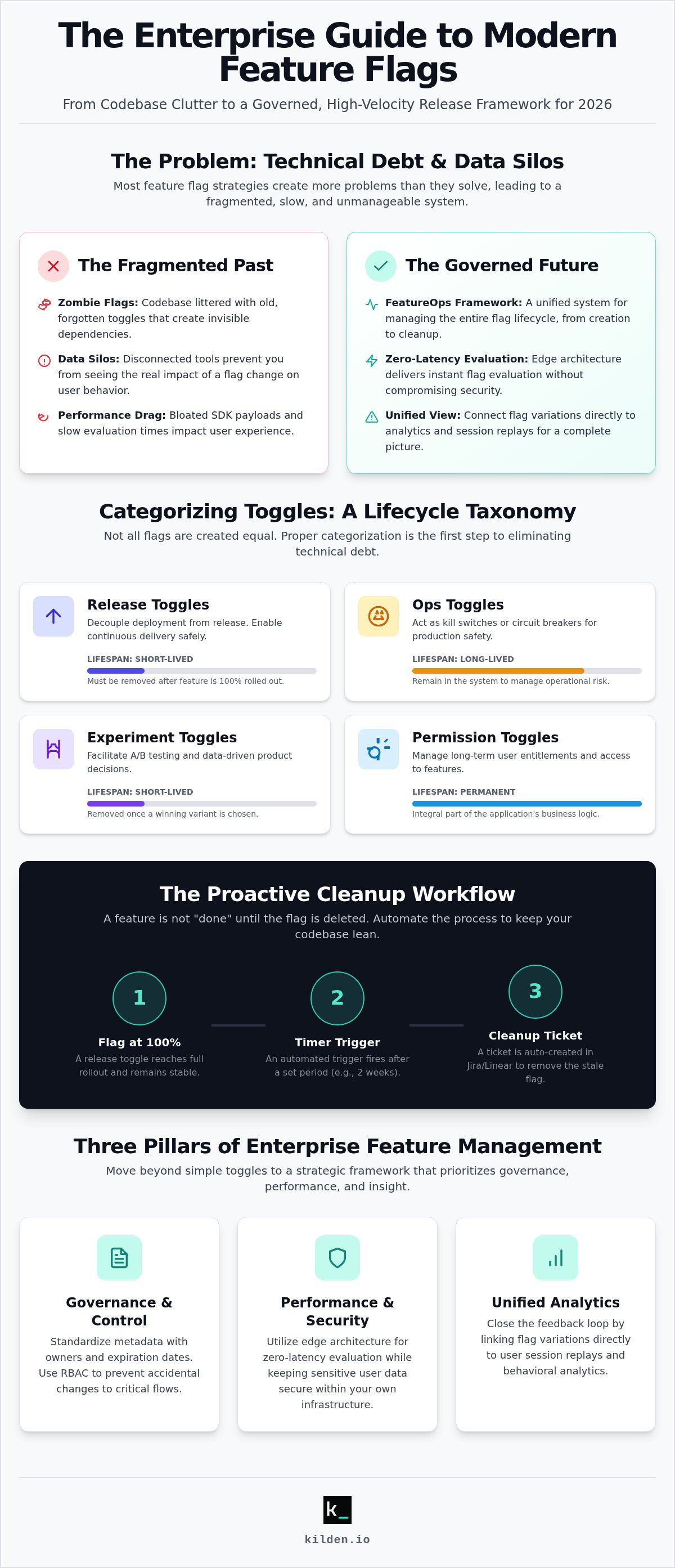
Your feature flagging strategy is likely creating more technical debt than it solves. Most teams treat flags as a quick developer utility. They aren't. In 2026, flags are a mission-critical governance framework. Without the right approach, you end up with zombie flags cluttering your codebase and SDK payloads that drag down performance. Implementing feature flag best practices for enterprise is the only way to prevent your infrastructure from becoming a fragmented mess.
You know the pain of data silos. You see a flag change but can't see the immediate impact on user behavior without jumping between three different tools. It's inefficient. It's also unnecessary. We're going to show you how to master the architecture and lifecycle management required to run flags at scale without the typical enterprise lag.
This article provides a roadmap for a clean, governed flag lifecycle. You'll learn how to achieve zero-latency flag evaluation and create a unified view of your data. We're moving past the chaos toward a system that prioritizes clarity, unity, and technical agility.
Key Takeaways
- Stop shipping in the dark. Transition from simple toggles to a FeatureOps framework to handle the complexity of 2026 enterprise environments.
- Master feature flag best practices for enterprise by eliminating zombie flags. Assign strict ownership and expiration dates to every toggle before it hits production.
- Prioritize evaluation speed and data security. Use edge architecture to ensure zero-latency performance while keeping sensitive user data inside your infrastructure.
- Bridge the gap between code and behavior. Link feature variations directly to session replays to see exactly how your changes impact real users.
- Remove adoption friction. Choose unified platforms that eliminate per-seat licensing, allowing your whole organization to participate in the release process.
Table of Contents
- Scaling Feature Flags: Why Enterprise Complexity Demands Governance
- Categorizing Toggles: Managing the Flag Lifecycle
- Enterprise Architecture: Performance and Security
- Closing the Feedback Loop: Integrating Flags with Analytics
- Strategic Feature Management with Kilden
Scaling Feature Flags: Why Enterprise Complexity Demands Governance
In 2026, the term "feature toggle" is a relic. What started as a simple what is a feature toggle? has evolved into a complex operational layer. Simple if/else statements work for a single developer. They fail for fifty squads. When you scale, you don't just need code; you need governance. This is why feature flag best practices for enterprise move from a developer convenience to a mandatory survival strategy. Without a framework, your release process becomes a liability.
Hard-coded logic creates invisible dependencies. You can't audit a raw if/else block from a pull request six months ago. You can't see who enabled it or why. At enterprise scale, these simple toggles become "zombie" logic. They haunt your production environment and bloat your codebase. 89% of companies using feature flags report an improvement in release speed, but that speed vanishes when you're managing hundreds of flags across disconnected tools. You need a single source of truth for feature state. Without it, your system is just a collection of fragmented guesses.
The FeatureOps Mindset
FeatureOps is the intersection of DevOps and Product Management. It's the process of operationalizing every release to ensure safety and clarity. First, define ownership. Developers write the code, but Product Managers or SREs should often be the ones to flip the switch. Second, standardize metadata. Every flag must include an owner, a creation date, and a clear purpose for auditing. Finally, implement Role-Based Access Control (RBAC). A junior engineer should never have the power to accidentally disable a global checkout flow. Production safety requires intentional limits and precise permissions.
Governance vs. Velocity
Governance shouldn't be a bottleneck. It's a safety rail that allows you to move faster. Start with a naming convention that eliminates ambiguity. Use a pattern like Namespace/Team/Feature/Type. This makes auditing instant and search results meaningful. For high-risk infrastructure toggles, automate the approval process. If a flag impacts core services, require a secondary sign-off. The real danger is fragmentation. When flags and analytics don't share a unified identity, you lose the truth. You see a drop in conversion but can't link it to a specific variation. Effective feature flag best practices for enterprise demand that your flags, analytics, and session replays live in the same ecosystem. This is how you achieve wholeness in your data and maintain technical agility.
Categorizing Toggles: Managing the Flag Lifecycle
Flags aren't a monolith. Treating a temporary release toggle like a permanent kill switch is a recipe for a bloated codebase. In enterprise environments, technical debt doesn't just happen. It accumulates in the dark through "Zombie Flags." These are toggles left behind after a feature is 100% rolled out. They clutter your logic. They confuse your team. True feature flag best practices require a clear taxonomy. You must define the lifespan of a flag before you write the first line of code. This is a core part of feature flag best practices for enterprise success.
Short-Lived vs. Permanent Toggles
Distinguish your tools by their purpose. Release toggles are temporary bridges. They facilitate continuous delivery by decoupling deployment from release. Once the feature is stable, the flag must die. Ops toggles, like kill switches or circuit breakers, are long-lived. They sit in your infrastructure to protect against traffic spikes or third-party API failures. SRE teams rely on these for production safety. Experimentation toggles drive A/B testing. Their life ends once you've gathered enough data to make a decision. Misidentifying these categories leads to technical debt that slows down every subsequent deployment. Permission flags are the only truly permanent category, managing long-term access like subscription tiers or user entitlements.
The Cleanup Workflow
A feature is not "done" until the flag is deleted. To manage this at scale, you need a proactive cleanup strategy. Set an expiration date at the moment of creation. If a rollout reaches 100% and stays there for two weeks, it's stale. Automate this. Use triggers to create cleanup tickets in Jira or Linear. This keeps the codebase lean and the developers focused. You should also implement a "Flag Debt" dashboard. This visualizes exactly how much legacy logic is sitting in your production environment. It turns an invisible problem into a trackable metric. According to 2026 industry standards, a feature is only considered "shipped" once its associated flag code is purged.
Code-level discipline is equally vital. Don't scatter flag logic throughout your components. Abstract it. Create a wrapper or a service layer to handle evaluation. This minimizes the footprint of each toggle. When it's time to delete, you remove a single reference instead of hunting through ten files. It's about technical agility. If you're tired of fragmented tools making this process harder, Kilden provides a unified identity across flags and analytics. This allows you to see the exact moment a flag becomes redundant so you can kill it with confidence. You gain a clean codebase and a faster release cycle without the manual overhead.
Enterprise Architecture: Performance and Security
Architecture isn't just about where your code lives. It's about the millisecond between a user landing on your page and the UI responding. If your SDK initialization takes 300ms, your feature flags are a performance bottleneck. Most enterprise teams struggle with "Flag Bloat." They send the entire state of every flag to the client in a massive JSON payload. This causes UI flickering and kills your Core Web Vitals. Stop compromising on speed. Implementing feature flag best practices for enterprise requires a shift from centralized to distributed evaluation. Privacy and performance must be built into the foundation, not bolted on later.
Security is the other half of the equation. Many legacy systems require you to send sensitive user attributes to their servers for targeting. This is a compliance nightmare. Personally Identifiable Information (PII) should never leave your infrastructure. Your architecture should support local or edge evaluation where the decision happens close to the user, but the data stays under your control. For a deeper dive into the technical foundations of these patterns, Martin Fowler's guide to feature toggles remains the industry standard for understanding how to structure these systems without creating a maintenance disaster.
Evaluation at the Edge
Edge evaluation is the 2026 standard for high-scale applications. By moving flag logic to the CDN, you eliminate the round-trip to a central server. This provides zero-latency evaluation. It also ensures a consistent experience across distributed systems. If a user moves from a mobile app to a web portal, their experience remains identical. For development and QA, ensure your architecture supports local overrides. Engineers need to force specific flag states in their local environments without affecting production data or triggering global audit logs. This balance of global consistency and local flexibility is a hallmark of feature flag best practices for enterprise.
Security and Compliance
Enterprise security demands a "Closed by Default" posture. If the SDK fails to connect or a flag is missing, the feature must remain off. This prevents unauthenticated users from seeing sensitive beta features. Audit logging is equally critical. You need a tamper-proof record of every state change, showing who flipped the switch and when. This is mandatory for SOC2 and ISO 27001 compliance. To protect user privacy, follow this protocol for PII-free evaluation:
- Hash the identifier: Convert the user's email or ID into a unique hash on your own server.
- Synchronize targeting rules: Pull the targeting logic from your flag provider to your local environment or edge worker.
- Evaluate locally: Match the hashed ID against the targeting rules within your own secure perimeter.
- Return the result: Pass only the boolean "true" or "false" to the application logic.
This approach ensures that your flag provider never sees a single byte of sensitive user data. It keeps your infrastructure secure while maintaining the agility of a modern release framework.
Closing the Feedback Loop: Integrating Flags with Analytics
Shipping code is the easy part. Knowing if that code actually solved a user's problem is where most enterprises fail. "Dark Launches" are a silent killer of product quality. You release a feature behind a flag, ramp it to 10% of your users, and then wait. You have no visibility. You're waiting for a support ticket or a crash report to tell you if something is wrong. This is the opposite of feature flag best practices for enterprise. If your flags don't talk to your analytics, you aren't managing features. You're just hiding them.
The problem is usually the "Data Tax." Most platforms treat flags and analytics as separate worlds. You pay for a flag provider. You pay for an analytics tool. Then you pay a third time in engineering hours and egress costs to sync the two. Fragmented systems create data silos. To truly master feature flag best practices for enterprise, you need a unified identity. When a flag variation is served, that event must be instantly available in your behavior data. No syncing. No delays. Just a single source of truth for every user interaction.
Visualizing the Impact
Quantitative data tells you what happened. Session replay tells you why. Every feature flag evaluation should include an automatic link to a session replay. If your conversion rate drops for users in "Variation B," don't guess. Watch them. You might discover a UI flicker or a broken button that only appears in that specific state. Heatmaps and clickmaps should also be segmented by flag variation. This allows you to see exactly how a new feature changes navigation patterns. You're bridging the gap between "the flag is on" and "the user is successful." It's about finding the truth in the human experience behind the telemetry.
Automated Experimentation
Stop treating A/B testing as a special event. It should be the default state of every release. Modern feature management allows for continuous optimization. You don't just launch; you iterate based on real-time statistical significance. For the enterprise, this means understanding the math behind the metrics. You need to know if a 2% lift is a real trend or just noise. You can Learn how to measure feature success the right way by focusing on outcomes rather than just output. When your flags are integrated with your metrics, you move from manual guesswork to automated confidence.
Efficiency comes from wholeness. If you're tired of jumping between disconnected dashboards, Kilden eliminates the tool sprawl by combining flags, analytics, and session replay into one SDK. You get a clear view of how every code change impacts your bottom line without the data tax. It's time to stop guessing and start seeing the full picture.
Strategic Feature Management with Kilden
Governance is a theory until you have the right tools to enforce it. You can't master feature flag best practices for enterprise if your software creates friction at every turn. Most platforms punish your growth with a "per-seat tax." They charge you for every developer, product manager, and analyst who needs access to the dashboard. This forces teams to share logins or limit visibility, which is the fastest way to break your security posture and audit trails. Kilden eliminates this budget friction. We believe every person in your organization should have a seat at the table without increasing your overhead.
Technical agility requires a unified stack. When flags, analytics, and session replay live in separate silos, your data is fragmented. You're forced to spend engineering hours stitching together disparate events just to see if a new feature works. Kilden solves this with a single SDK. This unified identity means your feature variations are automatically linked to user behavior. You get a whole view of your product's health without the data engineering debt. It's a performance-first architecture designed for zero-latency evaluation at the edge, ensuring your UI stays fast while your releases stay safe.
The Kilden Advantage
The cure for tool sprawl is consolidation. Kilden provides a single platform for the entire product lifecycle. This isn't just about flipping switches. It's about closing the loop. Because our feature flags are natively integrated with session replay, you can validate the impact of a rollout instantly. If a user experiences a specific flag variation, you can watch their session to see exactly where they struggle. You can even trigger in-app surveys based on flag states to get direct feedback from users in a specific beta group. This level of integration is what separates basic toggling from strategic feature management.
Getting Started
Moving to a modern system shouldn't be a headache. You can migrate from legacy flag providers to Kilden without downtime. Our SDKs are built for high-velocity teams that require SOC2 compliance and robust audit logging from day one. You can set up your first governed rollout in minutes, applying the naming conventions and targeting rules we've discussed throughout this guide. It's time to stop managing chaos and start managing features. Start managing enterprise feature flags with Kilden today and see the relief that comes from a clean, unified workflow. You're not just buying a tool; you're adopting a more logical way to build software.
Build a Release Engine, Not a Technical Debt Factory
Enterprise scale demands more than just toggles. It requires a rigorous governance framework. You've seen how zombie flags and data silos create chaos. Transitioning to a FeatureOps mindset ensures your team moves fast. Implementing feature flag best practices for enterprise isn't just about code. It's about achieving a unified view of how every change impacts your users.
Fragmentation is the enemy of clarity. When your flags, analytics, and session replays live in different worlds, you lose the truth. You need a system that offers zero-latency evaluation and a SOC2 compliant architecture. Stop guessing why a feature is underperforming. See it for yourself with integrated session replay. It's time to empower your entire organization with a platform that doesn't punish your growth with per-seat licensing. Stop paying for fragmented tools. Start your Kilden trial today.
The logic is simple. Complexity is a choice. Efficiency is a strategy. Build something better today.
Frequently Asked Questions
What is the difference between a feature flag and a feature toggle?
They are essentially synonyms. However, "toggle" often describes a local if/else statement used during development. "Flag" implies a managed, remote system used at scale. In 2026, we use "feature flags" to describe the governed infrastructure of FeatureOps. It's about moving from simple code switches to a mission-critical release framework. Both serve the same technical purpose, but flags are built for the scale and auditability required by modern enterprise teams.
How many feature flags are too many for an enterprise team?
It's not about the count. It's about the lifecycle. If you have 200 flags but no expiration dates, you have too many. High-performing teams maintain hundreds of active flags by ensuring the vast majority are short-lived. Use a "Flag Debt" dashboard to track staleness. When a flag hits 100% rollout, it's a liability. True feature flag best practices for enterprise dictate that every flag must have a defined owner and a death date.
How do you manage feature flags in a microservices architecture?
Centralize the logic; distribute the evaluation. Don't let each service manage its own local config. That leads to inconsistent user experiences. Use a unified provider that evaluates flags at the edge or through a sidecar. This ensures a user gets the same variation in the "Checkout" service as they do in "Inventory." Consistency across distributed systems is the only way to maintain a single source of truth across your entire infrastructure.
Should feature flags be stored in a database or a configuration file?
Neither. Config files are static and require a redeploy. Local databases are hard to sync across clusters. Use a dedicated feature management platform. These systems evaluate logic at the edge or within a local SDK cache. This gives you the speed of a local file with the flexibility of a remote dashboard. It's the only way to achieve instant updates without the risk and delay of a full production deployment.
How do you prevent 'flicker' when using client-side feature flags?
Flicker happens when the UI renders before the flag evaluates. Stop using async fetches during the render cycle. Instead, bootstrap the initial flag state. Inject the required flags directly into the server-side HTML payload. The client-side SDK can then read this state instantly. This eliminates the "pop-in" effect. It keeps your Core Web Vitals healthy and ensures a seamless experience for every user from the first millisecond they land on your site.
What are the best practices for naming feature flags in a large organization?
Use a hierarchical namespace. A flat list of names like "new-checkout" is a disaster in a large organization. Adopt a pattern: [Department]-[Team]-[Feature]-[Type]. For example, billing-payments-stripe-v3-release. This makes searching and auditing instant. It also simplifies automated cleanup. If a flag doesn't follow the convention, don't let it pass the PR stage. Consistency is the foundation of governance at scale.
How do you handle feature flag cleanup in a CI/CD pipeline?
Automate the cleanup trigger. Use a script in your CI/CD pipeline to identify flags that have been at 100% for over 14 days. Don't just alert; act. Create a Jira ticket or fail the build if a stale flag persists. A feature is only "shipped" when the flag code is deleted. This prevents technical debt from accumulating in the dark and keeps your codebase lean and maintainable for the long term.
Can feature flags be used for permanent infrastructure configuration?
Yes, but they need a different label. Categorize these as "Ops Flags" or "Permission Toggles." These handle kill switches, circuit breakers, or subscription entitlements. Unlike release flags, these are permanent. They require different permissions and regular security audits. Following feature flag best practices for enterprise means separating these long-term controls from temporary release logic. This prevents accidental deletion during routine code cleanups.