Unified Product Analytics and Engagement: The End of the Fragmented Stack

on this page ▾
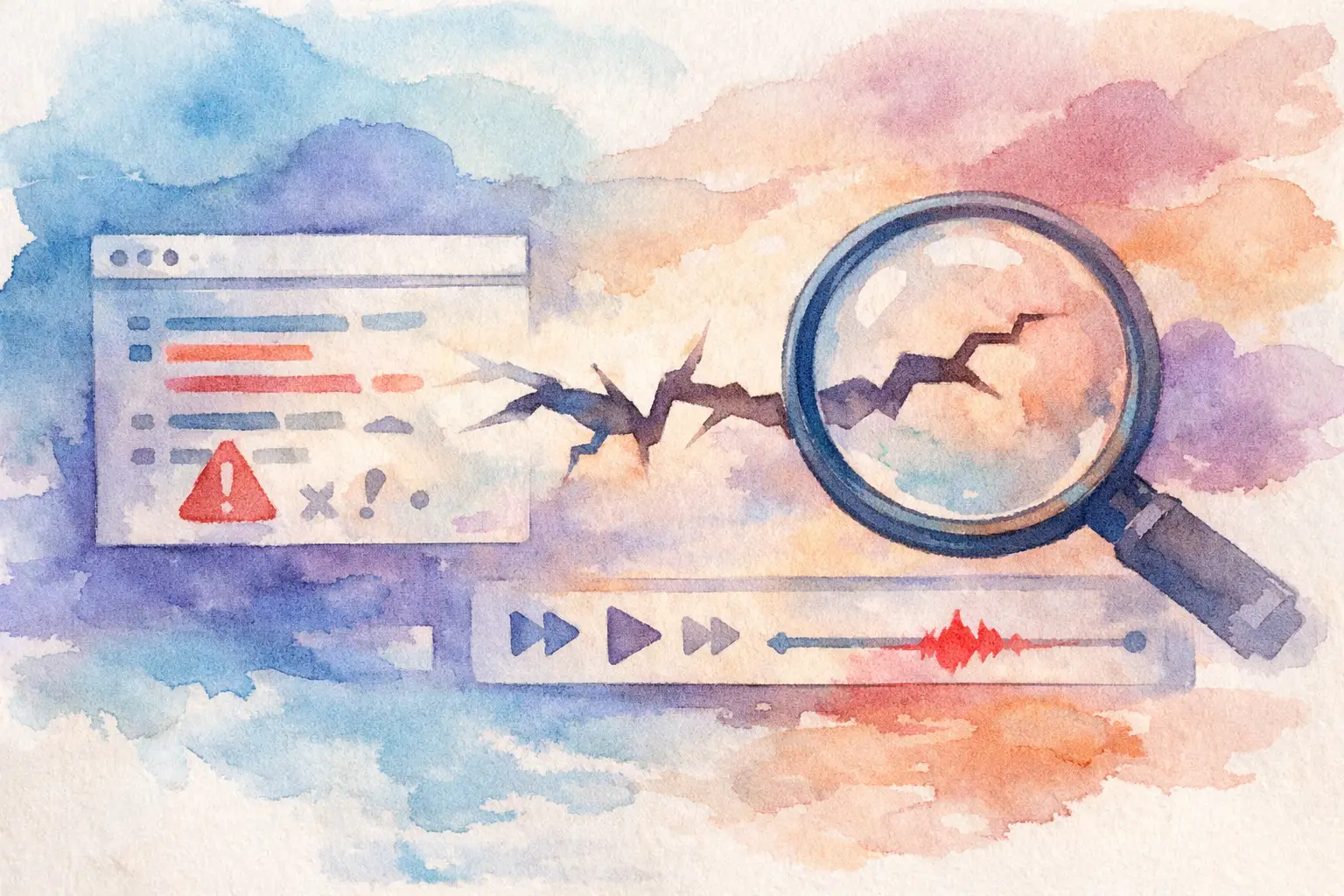
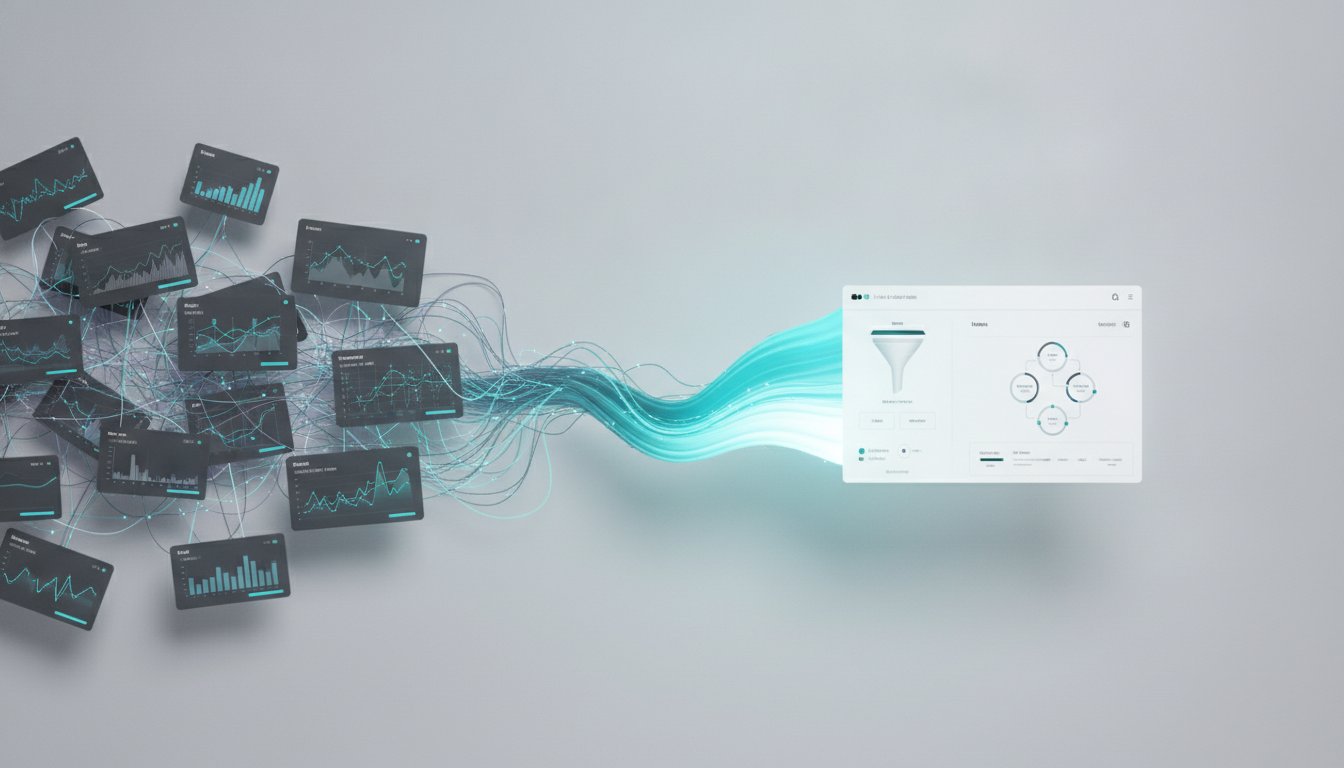
The modern data stack is a pile of broken promises. You pay for five different tools, yet your analytics still don't talk to your messaging platform. This fragmentation creates a lag that kills growth. It's time to move toward unified product analytics and engagement. When your data and your actions live in the same place, the friction disappears. You stop managing integrations and start managing your product.
You're likely tired of the per-seat tax and the constant headache of mismatched user IDs. It's frustrating to see a user struggle in a session replay but have no way to help them for another twenty-four hours. This article explains how a single platform solves these pains. You'll learn how to trigger in-app actions instantly using live data while slashing your total software spend. We will break down the shift from fragmented silos to a streamlined system that prioritizes the human on the other side of the screen.
Key Takeaways
- The "Frankenstein Stack" is a silent killer of productivity. Learn why a fragmented data ecosystem prevents a clear view of user behavior.
- Transition to unified product analytics and engagement to solve the identity crisis and maintain a single, consistent profile for every user across all tools.
- Turn insights into immediate action. Discover how to trigger product tours and messages based on live behavioral data rather than waiting for sync cycles.
- Identify friction points with surgical precision. Use the combination of funnel analysis and session replay to see exactly where and why users drop off.
- Reclaim your budget. Explore how moving to a unified platform eliminates redundant per-seat licensing fees and simplifies your technical architecture.
Table of Contents
- The High Cost of the Fragmented Product Stack in 2026
- Defining Unified Product Analytics and Engagement
- Data Silos vs. Single Source of Truth: The PLG Catalyst
- Implementing a Unified Strategy: From Insight to In-App Action
- The Kilden Advantage: Unifying Growth Without the Per-Seat Tax
The High Cost of the Fragmented Product Stack in 2026
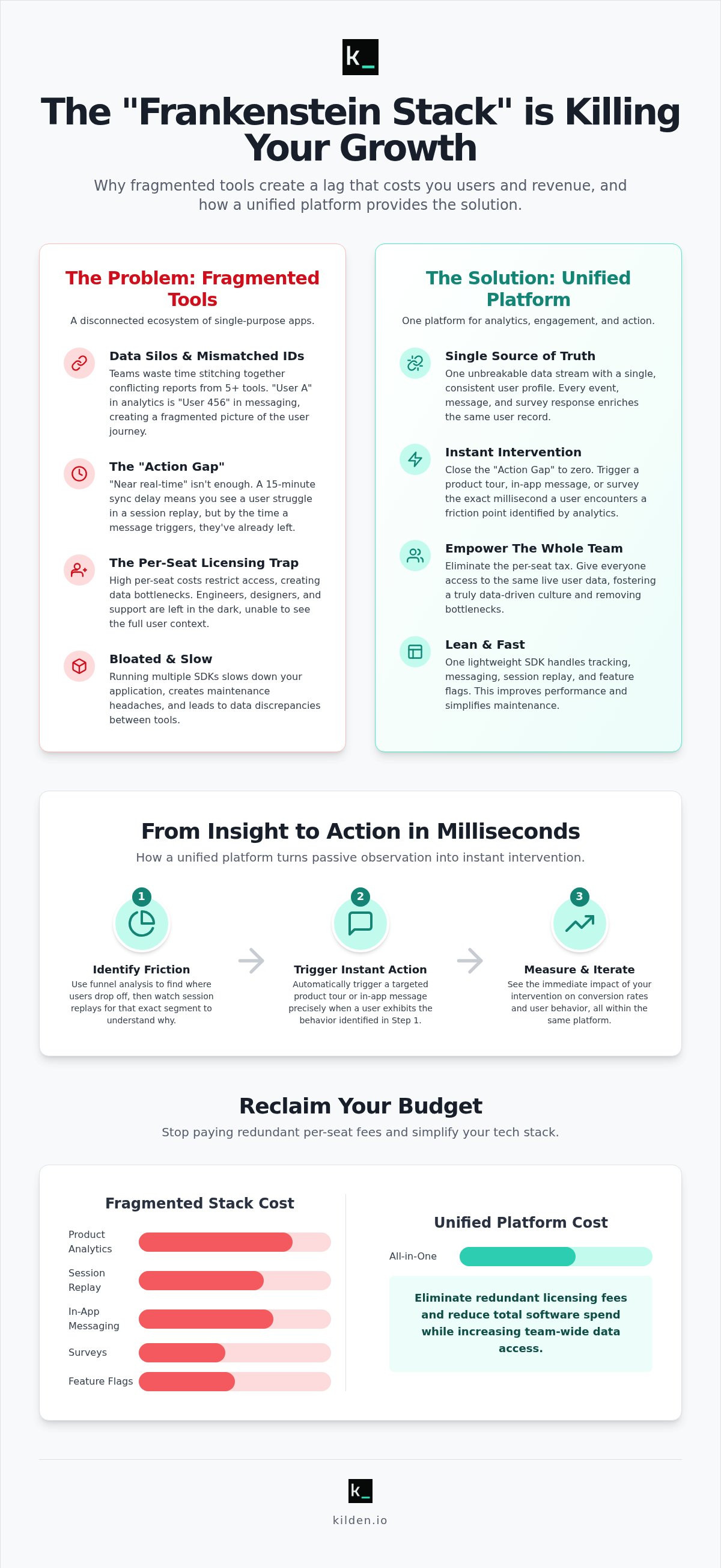
Most product teams are drowning in tools but starving for clarity. The "Frankenstein Stack" has become the industry standard. You use one tool for analytics, another for session replay, and a third for in-app messaging. You might even have separate platforms for feature flags and surveys. This fragmentation creates a 0% clear picture of the user journey. When you rely on five different tools to track a single user, you don't get a single source of truth; you get a fragmented mosaic of conflicting events. Transitioning to unified product analytics and engagement isn't just a technical upgrade. It's a survival strategy for teams tired of paying a hidden tax on their productivity.
Data silos are the primary culprit. Your team spends more time stitching reports together than they do building features. Integrations are often sold as the solution, but they're usually just band-aids. They don't provide the real-time agility needed for modern growth. You're left in a state of passive observation. You see what happened yesterday, but you can't change what's happening right now.
The Latency Gap: Why 'Near Real-Time' Isn't Enough
"Near real-time" is a marketing lie. If your analytics tool takes 15 minutes to sync with your messaging tool, you've already lost the user. You see a user struggle with a checkout error in a session replay, but by the time your automated message triggers, they've already closed the tab. We define the Action Gap as the time between user friction and product response. In a fragmented stack, this gap is measured in minutes or hours. That's too slow. Modern product growth requires instant intervention. If a user is stuck, they need a product tour or a messenger prompt exactly when the friction occurs, not after a data sync cycle finishes.
The Licensing Trap: Seat Costs vs. Product Growth
Per-seat pricing is the enemy of a data-driven culture. When every new login costs your company money, access becomes a privilege. Managers restrict seats to save budget. This leaves engineers, designers, and support staff in the dark. They're forced to rely on "filtered" truth from a few people with access. It's inefficient and creates bottlenecks. A unified product analytics and engagement platform changes the economics. By removing the per-seat tax, you empower the whole team. Everyone sees the same data. Everyone understands the user's pain. The economic argument is simple: stop paying for seats and start paying for results. Total visibility shouldn't be a luxury; it should be the foundation of your workflow.
Defining Unified Product Analytics and Engagement
True unified product analytics and engagement isn't just about having two tools on the same dashboard. It's about a single, unbreakable data stream. Most platforms treat data and action as separate silos. You track behavior in one place and send messages from another. This separation is a relic of old architecture. In a unified system, every event is a potential trigger. Every message is a data point. You don't just "integrate" your tools; you merge them into a single source of truth.
A Single User Identity is the foundation of this approach. It's one profile for tracking, testing, and talking. You don't have to worry about "User A" in your analytics tool being "User 456" in your messenger. It's the same human. This continuity allows you to build a feedback loop that actually works. When a user completes an in-app survey, that response immediately enriches their behavioral profile. Messenger and in-app campaigns become the front-end of your data strategy. They aren't just communication channels; they're active sensors that collect data and drive behavior simultaneously.
The Mechanics of a Unified Data Stream
Performance matters. Running five different SDKs slows down your application and creates maintenance nightmares. A unified platform uses one SDK to handle everything. This reduces overhead and eliminates the data discrepancies common in multi-tool stacks. It also enables high-velocity growth tactics. For example, you can trigger a Product Tour the exact millisecond a user hits a specific friction point identified by your analytics. Session replays become far more valuable when they are automatically tagged with engagement history. You aren't just watching a video; you're seeing the context of every intervention your team attempted.
If you're tired of managing a bloated stack, it's time to explore a unified alternative that prioritizes efficiency over complexity.
Feature Flags: The Bridge Between Dev and Growth
Feature flags shouldn't just be for safe deployments. They're powerful engagement tools. In a unified system, you can run targeted experiments without waiting for a code deploy. You can toggle features for specific segments and immediately correlate those changes with retention metrics in the same view. Unified feature flags prevent experimentation blindness by ensuring the team observing the metrics has direct control over the feature state, removing the gap between seeing a problem and fixing it. By building on a foundation of unified product analytics and engagement, you ensure that every product change is measured against real user outcomes, not just technical success.
Data Silos vs. Single Source of Truth: The PLG Catalyst
Product-Led Growth (PLG) is a strategy, not a magic trick. It fails when your data is fragmented. If your product is the primary driver of acquisition and retention, you need to see exactly how users interact with it. You can't do that when your behavior data lives in a different world than your engagement tools. This "Identity Crisis" is the silent killer of PLG. User A might be a power user in your analytics platform but appear as a dormant lead in your messenger tool. This mismatch leads to embarrassing mistakes. You send a "How to get started" banner to someone who has been using the app for three years. It's noisy. It's unprofessional. It breaks the trust you're trying to build.
Adopting unified product analytics and engagement fixes this. It ensures your communication is always consistent with your goals. When a user hits a milestone, the system knows. There's no delay. No manual sync. You treat the human behind the screen with the respect they deserve by providing contextual support that actually matters. You aren't just pushing notifications; you're facilitating a journey based on a single, shared reality.
Accelerating Product Velocity
Speed is your only real advantage. Fragmented stacks create data engineering bottlenecks. Every time a PM wants to launch a new in-app campaign, they have to open a Jira ticket. They wait for a developer to instrument a new event or sync a database. That's a waste of talent. A unified stack allows PMs to launch campaigns without engineering help. You move from insight to action in minutes. This instant feedback loop informs your roadmap with real, live data rather than guesses. When you reduce the "Time to Insight," you increase your ability to out-experiment the competition.
The Single Source of Truth (SSOT) Advantage
Stop arguing over which tool is "correct." In a fragmented stack, your analytics might show 1,000 active users while your messenger shows 800. These discrepancies lead to endless meetings and zero progress. Moving to a single source of truth eliminates this friction. It also simplifies your security posture. It's much easier to maintain compliance and data privacy when you're auditing one platform instead of five. For more on this, read about Eliminating Data Silos in Product Analytics. Choosing unified product analytics and engagement means choosing clarity over chaos. It's the logical choice for teams that value truth over technical debt.
Implementing a Unified Strategy: From Insight to In-App Action
Data without action is just an expensive hobby. Most teams have plenty of charts but no way to change the numbers. A unified product analytics and engagement strategy bridges this gap. It turns passive observation into active intervention. You don't need a three-week development cycle to fix a UX hurdle. You just need a logical workflow that moves from the "what" to the "why" and finally to the "how."
- Step 1: Map the 'Golden Path.' Use funnel and path analysis to define the ideal user journey. Identify exactly where the leaks are happening.
- Step 2: Identify friction points. Switch from the funnel view to session replay and heatmaps. Watch the specific users who dropped off. Look for rage clicks or circular navigation.
- Step 3: Deploy targeted intervention. Don't wait for the next sprint. Launch a Product Tour or an In-app Banner for that specific segment. Direct them back to the Golden Path.
- Step 4: Validate success. Use integrated A/B testing and feature flags to measure the impact. If the intervention works, keep it. If not, kill it and try again.
The 'Insight-to-Action' Workflow
Efficiency relies on automation. You can't watch every session replay manually. Instead, set up behavioral triggers. If a user visits the pricing page three times but doesn't upgrade, trigger a messenger prompt. Use in-app surveys to ask "Why" at the exact moment the "What" happens. This provides qualitative data that raw events can't capture. We define a Contextual Prompt as the highest form of engagement because it delivers a solution at the precise moment a user experiences a problem. If you're ready to stop watching users struggle and start helping them, get started with Kilden's unified platform.
Measuring What Matters
Monthly Active Users (MAU) is a vanity metric. It tells you people showed up, but it doesn't tell you if they found value. You should focus on Meaningful Feature Adoption. A unified product analytics and engagement stack allows you to track the ROI of an in-app messaging campaign in real-time. You can see the direct correlation between a Product Tour and a spike in feature usage. This clarity helps you justify your roadmap and prioritize the right fixes. For a deeper dive into these metrics, check out our guide on How to Measure Feature Success. Companies that optimize their analytics spending this way see a 3-4x better return on investment, according to Gartner's Magic Quadrant for Analytics Platforms.
The Kilden Advantage: Unifying Growth Without the Per-Seat Tax
We built Kilden because we were tired of the "Frankenstein Stack." The industry standard of paying for five different tools to understand one user is broken. It's expensive. It's slow. It's inefficient. Kilden is our response to that bloated status quo. We provide a single platform where unified product analytics and engagement are the default, not an afterthought. You get total visibility through one SDK that handles everything from session replays to in-app surveys.
Fairness is baked into our design. Most competitors charge you for every person who logs in. We think that's ridiculous. It's your data. You shouldn't have to pay a "seat tax" to let your engineers see a bug or your designers see a friction point. By removing per-seat licensing, we empower your whole team to be data-driven. You can scale your growth without the headache of managed data engineering or the fear of a ballooning monthly bill. You own your insights; you should be able to share them freely.
A Product Suite Built for Modern Teams
Kilden isn't just a recording tool. It's an active growth engine. Our suite integrates Messenger, Product Tours, and In-app Banners directly with your analytics. This means you can launch a tour for new users who haven't finished onboarding and see the impact on retention immediately. Our Feature Flags connect directly to these engagement campaigns. You can toggle features for specific segments and measure the result in the same view. We've built a "no-code" experience that doesn't sacrifice power. You get the technical precision of an enterprise tool with the agility of a startup.
Your Next Step Toward Unity
The path to efficiency starts with an audit. Count your current tools. Count the seats you're paying for. Look at the silos where your data goes to die. If you see more than three tools handling your product growth, you have a fragmentation problem. Moving to a unified platform doesn't take months of engineering. You can migrate in days. You stop managing integrations and start managing your product. It's time to choose clarity over complexity. Experience the power of unified product growth with Kilden and see what happens when your data and your actions share the same DNA. Start building a product that talks to its users based on the truth of their behavior.
Reclaim Your Product Velocity
Fragmentation is a choice you no longer have to make. Maintaining five different tools for one user journey is an expensive distraction that stalls your growth. We've shown that the path forward relies on unified product analytics and engagement. This shift eliminates the action gap, allowing you to move from behavioral insight to in-app intervention in seconds. It's about more than just better charts. It's about creating a single source of truth where your team can actually work together.
You deserve a stack that respects your budget and your intelligence. Stop wrestling with data syncs and per-seat licensing fees that punish your team's curiosity. With a unified SDK and a model built for high-velocity teams, you can finally focus on the human on the other side of the screen. The logic is self-evident. Efficiency is the only way to win in a crowded market.
Stop paying for silos. Start growing with Kilden.
The transition to a streamlined ecosystem is faster than you think. Take the first step toward a more logical, human-centric product strategy today. Your users will thank you for it.
Frequently Asked Questions
What is unified product analytics and engagement?
It's a single platform that combines behavioral data with the ability to take action in real-time. Instead of observing in one tool and messaging in another, you do both in one interface using a single data stream. This approach removes the latency and data discrepancies inherent in fragmented stacks. It turns passive observation into active intervention.
How does a unified platform differ from an integrated stack?
Integration is a band-aid; unification is the cure. An integrated stack relies on APIs to sync data between separate databases, which often leads to "near real-time" delays. A unified platform uses one database and one SDK. This ensures that an event in your analytics is immediately available to trigger a campaign or product tour without waiting for sync cycles.
Can a unified tool really replace specialized session replay or feature flag software?
Yes. Specialized tools often exist in a vacuum. In a unified system, your session replays are automatically tagged with engagement history. Your feature flags are directly tied to your retention metrics. You get the same depth of functionality with the added benefit of total visibility across the entire user journey.
Why is per-seat pricing bad for product analytics?
Per-seat pricing is a tax on curiosity. It forces managers to gate access to save budget, which creates data silos where only a few people see the truth. Product growth is a team sport. Engineers, designers, and support staff all need access to user behavior data to make informed decisions without worrying about a ballooning monthly bill.
Is it hard to migrate from multiple tools to a unified product platform?
It's simpler than maintaining a fragmented mess. Migration typically involves replacing multiple SDKs with one unified SDK and re-mapping your core events. Most teams complete the transition in days. You'll spend less time debugging broken integrations and more time building features that users actually want.
Does a unified SDK impact my application's performance?
It actually improves it. Loading one unified SDK is significantly more efficient than loading five separate ones for analytics, replay, messaging, and flags. You reduce the number of external requests and the total JavaScript bundle size. This leads to faster load times and a better experience for the human on the other side of the screen.
How does real-time data improve in-app messaging effectiveness?
It eliminates the Action Gap. When your data is truly live, you can trigger a messenger prompt or an in-app banner the exact moment a user hits a friction point. You don't have to wait for a 15-minute sync cycle to finish. This contextual relevance is the difference between a helpful nudge and a distracting notification.
Can I use feature flags for marketing experiments in a unified platform?
Absolutely. Feature flags are a bridge between development and growth. You can use them to toggle UI changes or new workflows for specific segments without a code deploy. Because it's part of a unified product analytics and engagement strategy, you can measure the impact on feature adoption and retention in the same dashboard instantly.