Behavioral Analytics for SaaS: 2026 Reference Guide


on this page ▾
Knowing what your users do is useless if you can't influence their next move. Most SaaS teams are stuck in a cycle of staring at dashboards while their messaging tools sit in a separate silo. You see the churn happening in real time, but your response is delayed by hours or days. It's a fragmented way to run a business. This 2026 guide to behavioral analytics saas is designed to end that frustration. We are moving past the "what" to help you understand the "why" behind every click.
You likely feel the weight of skyrocketing per-seat costs and the friction of disconnected data. It is exhausting to pay more for less clarity. We agree that your analytics should do more than just record history; they should drive the future of your product. In this reference guide, you'll learn how to establish a single source of truth for user identity and trigger immediate in-app actions based on real-time behavior. We will show you how to achieve predictable software costs while finally bridging the gap between seeing data and driving actual product growth.
Key Takeaways
- Move beyond vanity metrics like pageviews to track raw user events that reveal true intent and product value.
- Identify your product’s "Aha! Moment" by mapping the specific sequence of actions that leads to long-term retention.
- Close the "Action Gap" by integrating your behavioral analytics saas directly with engagement tools to eliminate data silos and technical debt.
- Prioritize "Time to Value" when evaluating your 2026 stack to ensure insights lead to immediate product improvements.
- Leverage a unified identity framework to trigger real-time in-app messaging and tours based on live user behavior.
Table of Contents
- Foundations: What is Behavioral Analytics for SaaS?
- The Mechanism: How Behavioral Data Fuels Product Growth
- The "Action Gap": Why Analytics Alone Is Not Enough
- Building Your Stack: Evaluation Criteria for 2026
- The Kilden Approach: Unified Behavioral Intelligence
Foundations: What is Behavioral Analytics for SaaS?
Stop looking at pageviews. They don't tell you if your product is working. Behavioral analytics for SaaS is the study of raw user actions, known as events, captured over time to reveal how people actually interact with your software. While web analytics focuses on how people find you, What is Behavioral Analytics? explains that this discipline looks at what they do once they are inside. It is the difference between seeing a crowd enter a store and knowing exactly which items they picked up, put back, or bought.
Traditional vanity metrics like sessions or bounce rates are noise. They provide a high-level view that masks individual frustration. In a SaaS environment, you need granularity. You need to know if a user who signed up yesterday has completed their first project or if they are stuck on the settings page. Behavioral analytics for SaaS is the process of turning every click into a data point that predicts whether a user will eventually churn or become a lifelong advocate.
The foundation of this entire system is User Identity. In the old world of analytics, data was fragmented across devices and sessions. In 2026, we prioritize a single source of truth. Every event is tied to a specific ID. This allows you to follow a human being across their entire lifecycle, from the first login to the thousandth feature export. Without a unified identity, your data is just a collection of anonymous dots that never form a coherent picture.
The Three Pillars: Events, Properties, and Cohorts
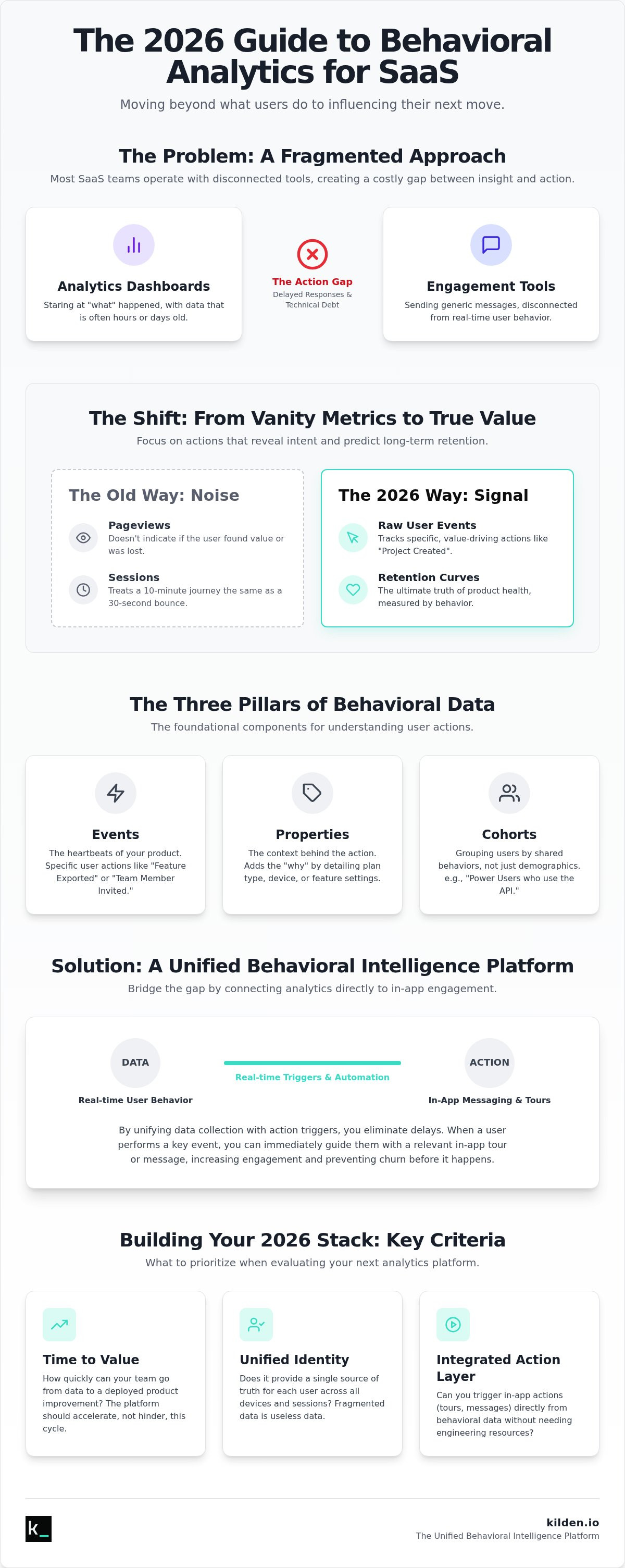
- Events: These are the heartbeats of your product. An event is a specific action, like "Feature Exported" or "Team Member Invited." These signals tell you exactly when a user is extracting value from your platform.
- Properties: This is the context behind the action. If "Feature Exported" is the event, the property tells you if the user is on a "Pro Plan" or a "Free Trial." It adds the necessary detail to understand the "why" behind the "what."
- Cohorts: Stop segmenting by geography or job title. Group users by shared behavior instead. A cohort of "Power Users" who use your API daily is far more actionable than a generic list of users located in North America.
Behavioral vs. Web Analytics (GA4)
GA4 is a marketing tool. It is built to track attribution and ad spend. It treats users as a series of disconnected sessions. SaaS does not live in sessions; it lives in journeys. You don't care that someone visited five pages in ten minutes. You care that they completed a specific, high-value workflow that leads to retention.
Modern product management requires a shift from "how many" to "who" and "why." When you focus on user journeys rather than sessions, you stop guessing why people leave. You start seeing the friction points. You move from counting visitors to understanding the humans using your software.
The Mechanism: How Behavioral Data Fuels Product Growth
Growth isn't a result of luck. It's the product of a repeatable loop. You track events, analyze the resulting patterns, form a hypothesis about user friction, and run experiments to fix it. This is how behavioral analytics saas transforms from a passive recording tool into an active growth engine. Without this feedback loop, you are just guessing. With it, you are engineering success.
Every successful SaaS has a tipping point, often called the "Aha! Moment." This is the specific action or sequence of actions that correlates most strongly with long-term retention. For some, it's inviting three team members. For others, it's completing a first data export. Behavioral data identifies these correlations by looking at what your most successful users did in their first 48 hours. Once you find that signal, your entire onboarding funnel should be redesigned to drive every new signup toward that specific event.
Retention curves are the ultimate truth in SaaS health. If your curve never flattens, your product is a leaking bucket. You must track these curves across every platform. A user might sign up on a laptop but do their daily work on a mobile app. In 2026, fragmented tracking is a liability. You need a unified view that follows the user identity across devices to understand true engagement. As you scale this tracking, maintaining privacy-first behavioral analytics is essential. Transparency about data collection builds the trust necessary for long-term customer relationships.
Quantitative vs. Qualitative: The Session Replay Bridge
Numbers tell you where users drop off, but they rarely tell you why. You might see a 40% abandonment rate on your checkout page, but you won't know if it's a broken button or a confusing form field. Session replays act as the qualitative bridge. By linking event triggers directly to session replay recordings, you can watch the exact moment a user gets frustrated. It turns abstract data into a clear directive for your engineering team.
Feature Adoption and the "Feature Grave"
Most SaaS platforms suffer from a "Feature Grave," where 80% of development effort goes into tools that only 5% of users ever touch. Don't measure success by simple feature clicks. That's a surface-level metric. Instead, measure "Depth of Adoption." Are users returning to the feature? Is it becoming a core part of their workflow? Stop building for the mythical "average" user. Use behavioral tracking to identify what your power users value and double down on those strengths.
The "Action Gap": Why Analytics Alone Is Not Enough
Data is passive. Action is active. Most SaaS teams have plenty of the former and none of the latter. This is the "Action Gap." It is the distance between discovering a user is struggling and actually doing something about it. When you implement behavioral analytics saas, the goal isn't just to watch. It's to intervene. Behavioral analytics saas should be a trigger for growth, not just a record of failure. If your analytics tool tells you a user is stuck but you have to wait for a weekly data sync to send them a help message, you've already lost them.
Fragmented stacks create "Identity Mismatch." This happens when your analytics tool identifies a user as one ID while your messaging tool sees them as another. Bridging this gap requires manual mapping or complex data engineering. It is an unnecessary tax on your growth. A unified identity is the only way to achieve true personalization. Without it, your "personalized" messages are just generic guesses based on stale data. You need one source of truth that follows the human, not just the device.
The High Cost of Fragmented SaaS Stacks
Maintaining multiple SDKs is a drain on engineering. Every new tool adds weight to your application and complexity to your codebase. Research shows the average company uses 101 SaaS applications, which leads to a massive "Data Latency" problem. Insights become stale by the time they reach the tools that can act on them. Some industry estimates suggest product managers lose up to 20% of their time simply moving data between these disconnected platforms. This is time that should be spent on strategy, not data plumbing. Stop paying for tools that create more work than they solve.
Closing the Loop with In-App Engagement
Closing the gap means moving from observation to automation. You need the ability to trigger in-app actions the moment a user shows "struggle" behavior, such as rage-clicking or circular navigation. Intervention must be immediate. If it isn't real-time, it isn't effective. Stop treating analytics and engagement as separate jobs. They are two halves of the same conversation with your user.
- Product Tours: Launch a targeted guide the second a user stalls on a complex setup page to prevent abandonment.
- In-App Surveys: Ask for feedback while the friction is fresh. This provides context that raw numbers can't reach.
- Feature Flags: Use real-time behavioral signals to roll back a problematic update before it impacts your entire user base.
Building Your Stack: Evaluation Criteria for 2026
Choosing a behavioral analytics saas platform in 2026 is no longer about comparing long lists of features. It is about speed and utility. The most critical metric you can track is "Time to Value." How quickly can you move from installing an SDK to seeing your first actionable insight? If a platform requires months of managed data engineering before you can answer a simple question about churn, it is failing you. Speed is your only competitive advantage.
You need "Zero-Engineering" engagement. This means your product and marketing teams must be able to launch product tours, in-app banners, and surveys without waiting for a developer's sprint cycle. Data is only as good as your ability to act on it. If every intervention requires a code change, you are moving too slowly. Prioritize platforms that offer no-code tools for direct user interaction. You should also ensure you maintain full data ownership without the unnecessary technical debt of on-premise hosting or complex infrastructure management.
Seat-Agnostic Scaling vs. Per-Seat Licensing
Per-seat licensing is a tax on collaboration. It forces you to decide which team members are "important" enough to see the truth about your users. Product growth is a team sport. Designers, engineers, and customer success managers all need access to the same behavioral data to do their jobs effectively. When you pay for every login, you create artificial silos that slow down decision-making. A seat-agnostic model allows for a "Whole Team" approach where data is democratized across the entire organization. Calculate your total cost of ownership by including the hidden costs of administrative friction and the lost opportunities caused by restricted data access.
The "Unified vs. Best-of-Breed" Debate
The "Best-of-Breed" strategy often results in a "Best-of-Bugs" reality. Stitching together five different specialized tools creates a fragmented user identity and massive data latency. For growth-stage companies, a unified platform is the superior choice. It eliminates the "Action Gap" discussed earlier by keeping tracking and engagement under one roof. You don't need more tools; you need more clarity. A single SDK reduces application weight and simplifies your codebase, allowing your engineers to focus on building features rather than managing integrations. Evaluate API robustness to ensure you can still export your data, but don't sacrifice unity for a marginal feature in a specialized tool.
Stop overpaying for fragmented data and start driving growth with a platform built for modern teams. Experience the power of seat-agnostic behavioral analytics with Kilden.
The Kilden Approach: Unified Behavioral Intelligence
Tool sprawl is the enemy of agility. When your data is scattered across five different platforms, you spend more time syncing than you do growing. Kilden is the antidote. We built a unified platform that combines product analytics, session replay, and a full engagement suite into a single SDK. This isn't just about convenience. It's about wholeness. By maintaining a single source of truth for user identity, Kilden ensures that the person you track in your analytics is the same person you reach with your messenger.
The "One Identity" framework is our answer to the fragmented user journeys of the past. You no longer have to guess if a user's frustration in a session replay is the same reason they ignored your last campaign. Everything is connected. This unified approach to behavioral analytics saas allows you to see the full human story behind the data. We prioritize utility over marketing jargon, providing a lean, muscular architecture that mirrors the efficiency of your own product development.
From Data to Action in One Interface
Stop waiting for engineering to deploy every small change. With Kilden, you can launch an in-app banner or a product tour based on a specific behavioral segment in minutes. You identify a struggle point, you create the intervention, and you go live. It's that simple. You can also manage feature flags and rollouts from the same dashboard where you analyze their performance. If an in-app survey reveals a recurring pain point, you can link that feedback directly to a session replay to see the exact moment of friction. This is how you close the loop.
Built for Collaborative Product Growth
Culture follows structure. If you charge per seat, you discourage your team from looking at the data. Kilden does not use per-seat licensing because we believe every member of your team should have access to the truth. Whether you're a senior engineer or a junior designer, you deserve to see how users interact with your work. This transparency builds a shared understanding of product value and eliminates the need for managed data engineering. It makes behavioral analytics saas a shared language across your entire organization.
Efficiency is not a luxury; it's a requirement. By choosing a unified platform, you reclaim the time typically lost to data plumbing. You focus on what matters: the human being on the other side of the screen. See how Kilden unifies your product growth stack and start bridging the gap between seeing data and driving real growth.
Own Your User Journey in 2026
The era of fragmented data and siloed teams is over. You've seen how the "Action Gap" stalls growth and how per-seat pricing punishes your best collaborators. Effective behavioral analytics saas requires more than just passive tracking; it demands a unified identity that lets you intervene the moment a user struggles. By combining tracking, session replay, and engagement, you transform raw events into immediate product improvements. You move from guessing to knowing.
It is time to stop managing complex integrations and start focusing on your users. Kilden eliminates the friction of tool sprawl by 4x. You get a unified analytics and engagement suite without the burden of per-seat licensing. This is the relief of clarity. It's a simpler, more logical way to build software that respects your technical intelligence. Stop paying per seat and start growing—Get started with Kilden. Your product deserves a single source of truth. Take control of your data and build a better user experience today.
Frequently Asked Questions
What is the difference between behavioral analytics and product analytics?
Behavioral analytics focuses on the granular actions users take, while product analytics is a broader category covering the entire lifecycle. Think of product analytics as the "what" and behavioral analytics as the "why." You use it to map specific event sequences. It reveals the friction points that high-level dashboards often ignore.
How does behavioral analytics help reduce SaaS churn?
It reduces churn by identifying struggle signals before a user decides to cancel. You can spot patterns like circular navigation or features that are ignored. Once you see the friction, you can trigger an in-app intervention. This proactive approach stops the leak in your funnel before it impacts your bottom line.
Can I use behavioral analytics without a dedicated data scientist?
You don't need a data scientist to get value from a modern behavioral analytics saas platform. These tools are built for product managers and engineers who need fast answers. Features like no-code event mapping and automated cohorting do the heavy lifting for you. You focus on the strategy while the software handles the data plumbing.
Why should I care about per-seat licensing in an analytics tool?
Per-seat licensing creates data silos that slow down your entire organization. If your engineers and designers can't see the user data, they can't build better features. It forces a culture of gatekeepers where data is hidden behind a paywall. Removing this barrier ensures that every decision is backed by evidence, not just the opinions of a few license holders.
How long does it take to implement a behavioral analytics SaaS platform?
Implementation of a behavioral analytics saas tool typically takes minutes to start seeing raw events. Deep event mapping for complex workflows might take a few days of coordination between product and engineering. The goal is Time to Value. You should be able to install a single SDK and see actionable data during your first coffee break.
What are the most important behavioral metrics for a new SaaS product?
Focus on your activation rate and the time it takes for a user to reach their Aha! Moment. These metrics tell you if your onboarding is actually working. You should also track cohort retention to see how different groups of users stick around over time. If these numbers aren't moving, your feature set doesn't matter.
Does behavioral analytics work for both web and mobile apps?
It works across both web and mobile apps to provide a unified view of the user. A person might start a task on their phone and finish it on a laptop. If your analytics can't connect those dots, your data is incomplete. Unified identity ensures you follow the human, not just the device they happen to be using.
How do session replays improve the accuracy of behavioral data?
Session replays add qualitative context to quantitative numbers. A dashboard might show a high drop-off rate on a form, but a replay shows the user couldn't find the submit button. It bridges the gap between seeing a problem and understanding it. You stop guessing why users leave and start fixing the specific UI friction that drives them away.