The 2026 Guide to Product Engagement Platforms: Bridging the Gap Between Data and Action


on this page ▾
Your product stack is likely a collection of expensive silos that refuse to talk to each other. You see user behavior in one window and try to trigger a message in another, hoping the integration doesn't break. The global market for engagement solutions is projected to reach over $28 billion this year, yet most teams are still stuck in this fragmented reality. A modern product engagement platform should bridge the gap between data and action, not create more work for your engineering team.
You probably agree that paying a "per-seat tax" just to let your team collaborate is both outdated and restrictive. It's frustrating to watch growth stall because your analytics and messaging tools live in different worlds. This 2026 guide promises a better way. You'll learn how to consolidate your tools, eliminate data silos, and finally create a single source of truth for user behavior. We will explore how to drive seamless in-app engagement using real-time data while maintaining a predictable, scalable cost structure. It's time to stop managing fragmented software and start growing your product with clarity and speed.
Key Takeaways
- Learn why a modern product engagement platform is the only way to bridge the gap between seeing user behavior and influencing it in real-time.
- Identify the hidden costs of data latency that occur when your analytics and messaging tools live in separate, disconnected ecosystems.
- Evaluate the true cost of ownership by looking past feature checklists to the restrictive per-seat licensing models that punish team collaboration.
- Master a two-phase implementation strategy that starts with mapping behavioral "Aha Moments" and ends with high-utility product tours.
- Discover how a unified identity across session replays and feature flags creates a more human-centric, efficient growth engine.
Table of Contents
- What is a Product Engagement Platform?
- The Architecture of Engagement: Why Data and Messaging Must Coexist
- Evaluating Platforms: Beyond the Feature Checklist
- Strategic Implementation: From Onboarding to Retention
- The Kilden Approach: Engagement Without the Per-Seat Tax
What is a Product Engagement Platform?
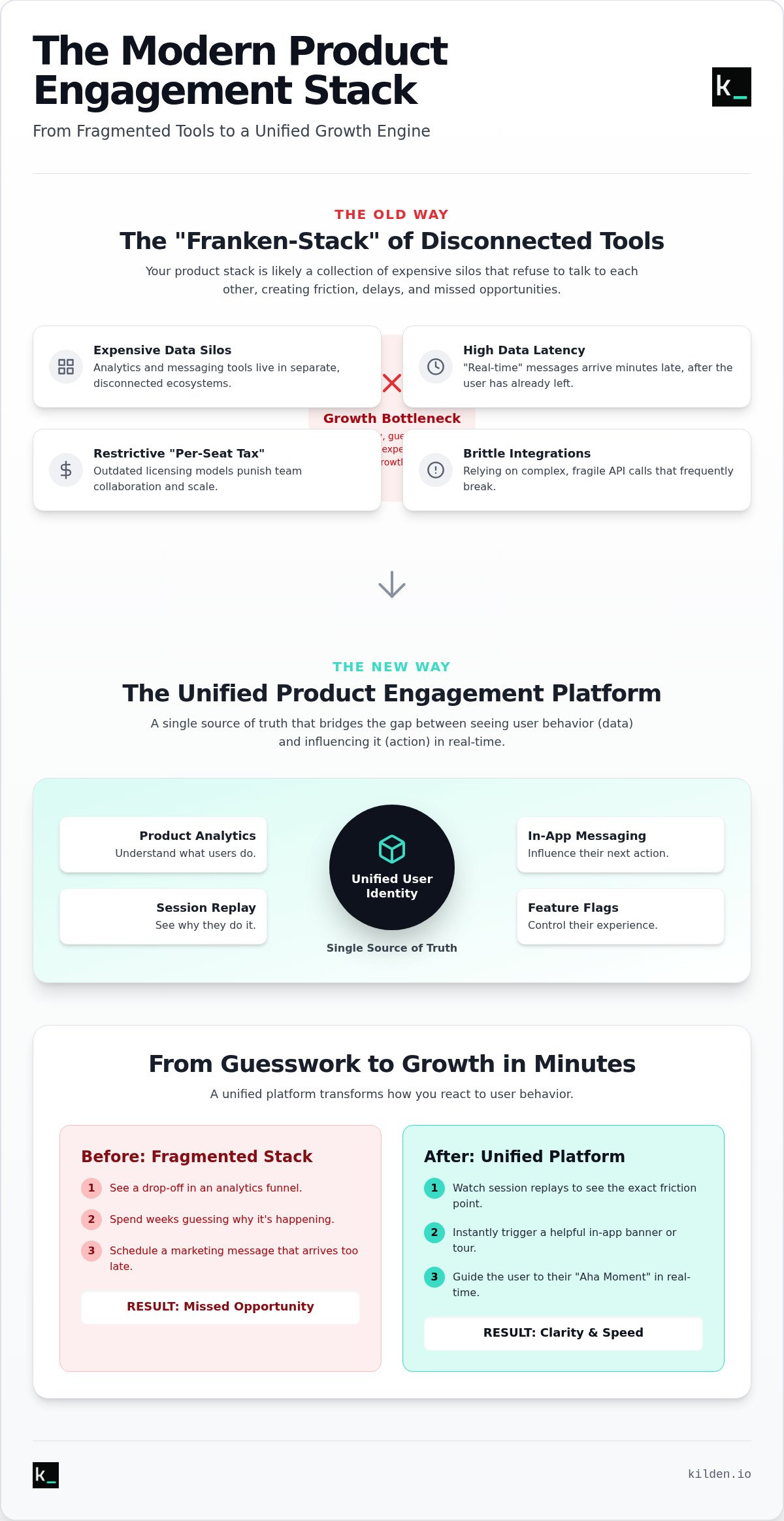
A product engagement platform is the software category that finally unifies user behavior data with active communication tools. It acts as the bridge between seeing what users do and influencing what they do next. For too long, software teams have relied on a "franken-stack" of disconnected tools. You might have one tool for analytics and another for product tours. These systems don't talk to each other. In 2026, this fragmented reality is no longer sustainable. Data silos lead to missed opportunities and broken user experiences.
The core components of a modern platform include Product Analytics, Session Replay, Feature Flags, and In-app Messaging. When these tools live in the same environment, you eliminate the friction of complex integrations. You get a single source of truth. You can see a user struggle in a session replay and immediately trigger a helpful banner or tour to guide them. This isn't just about sending messages. It's about creating a coherent, responsive environment that respects the user's time.
The Shift from Marketing to Product-Led Engagement
Traditional CRMs often fail at real-time product guidance. They are built for sales pipelines and marketing reach. While Customer engagement is a broad concept covering every brand interaction, product engagement is focused on utility. It happens inside the software itself. Product-led teams use a product engagement platform to drive self-serve adoption. They don't wait for a sales call. They use the product to sell the product. This shift requires tools that understand the nuances of user behavior, not just an email address.
Key Capabilities of Modern Platforms
Real-time behavioral triggers are the heartbeat of modern engagement. Scheduled batches are a relic of the past. If a user hits a specific milestone, they should see a congratulatory message or a new feature announcement instantly. This speed is only possible with a unified user identity. A shared data layer is non-negotiable. It ensures that every tool in your stack knows exactly who the user is and what they've done across every session.
Feedback loops are also critical for long-term retention. Modern platforms integrate in-app surveys and NPS directly into the user flow. You don't just guess why a user is leaving. You ask them when the experience is fresh. This data then feeds back into your analytics, allowing you to refine your product tours and feature flags. It's a closed loop that prioritizes human-centric growth over automated noise.
The Architecture of Engagement: Why Data and Messaging Must Coexist
Data silos aren't just an IT headache. They are a growth bottleneck. When your analytics tool and your messaging tool live in separate zip codes, data latency is inevitable. A ten-minute delay in data synchronization means your "real-time" welcome message is actually ten minutes late. The user has already closed the tab. You've missed the window. High-velocity teams can't afford to wait for batch processing or brittle API calls.
Closing the loop requires immediate action. Most teams see a drop-off in their funnel and spend weeks guessing why. With a unified product engagement platform, you skip the guesswork. You use session replays to see exactly where the user got stuck. Then, you trigger a product tour or an in-app banner to fix it. This isn't just about sending messages; it's about responsive product design. It's about moving from "what happened" to "how do we fix it" in minutes, not days.
The Power of Session Replay in Engagement
Heatmaps tell you where people click. They don't tell you why they're frustrated. Session replay is the contextual layer for behavioral analytics. It shows the hesitation before the exit. By identifying these friction points, you can deploy no-code banners to provide instant help. If you want to see this in action, you can explore unified engagement tools that keep your data and actions in one place. Moving beyond blobs of color to actual human behavior changes how you prioritize your roadmap.
Feature Flags: The Unsung Hero of Product Growth
Feature flags are often relegated to the engineering department. That's a mistake. They are the ultimate engagement lever. By decoupling deployment from release, you reduce risk. You can roll out a new feature to a small percentage of your power users and monitor their engagement scores in real-time. If the data looks good, you scale. If it doesn't, you kill it without a single line of code. This control allows for hyper-targeted experimentation without the fear of a broken production environment.
This synergy creates a smoother launch. Imagine a scenario where a feature flag turns on a new dashboard for a specific segment. Simultaneously, an in-app banner appears to explain how to use it. There is no lag. There is no broken integration. The data drives the message, and the message drives the adoption. This is how you build a product engagement platform that actually moves the needle on retention.
Evaluating Platforms: Beyond the Feature Checklist
Stop buying software based on a spreadsheet of features. Most platforms look identical on paper. The real differences appear when you look at the Total Cost of Ownership (TCO) and how the software treats your team. Choosing a product engagement platform is a strategic decision that affects your entire growth trajectory. If the platform is difficult to integrate or expensive to scale, it becomes a bottleneck rather than an accelerator.
Technical overhead is the silent killer of product velocity. Some platforms require managed data engineering just to get basic events flowing. If you need a specialist to build every report, the tool is a burden. Modern, plug-and-play platforms remove this middleman. They prioritize utility by using no-code tools to reduce developer dependency. This allows your engineers to focus on building core features while your growth team manages the engagement layers. You also need to look at integration depth. A platform that merely "syncs" data between modules creates lag. You need a shared data layer where analytics and messaging happen in the same breath.
The 'Per-Seat Tax' and Why It Matters
Seat-based pricing is a relic of the past that actively discourages collaboration. When every new login costs $50, $100, or even $150 per month, managers start gatekeeping access. PMs, developers, and support leads end up working in silos because the "per-seat tax" makes transparency too expensive. This is a growth killer. It forces your team to share logins or wait for screenshots instead of diving into the data themselves. In contrast, models that offer unlimited seats foster a unified product culture. Everyone sees the same truth. No one has to ask for permission just to check a session replay or verify a feature flag status.
Security and Hosting Considerations
Security is non-negotiable. By 2026, the industry has moved decisively toward cloud-hosted solutions; cloud-based deployment held a 68.4% market share back in 2025. You must ensure your platform complies with global standards like GDPR and CCPA. Authoritative certifications such as SOC 2 Type II or ISO 27001 are essential for any tool tracking user behavior. These aren't just badges. They are proof that your user data is handled with technical precision and respect. Scalability is the final piece of the puzzle. Ensure the platform won't slow down your app as your user volume grows. High-velocity engagement requires a lightweight footprint that can handle millions of events without flinching.
Strategic Implementation: From Onboarding to Retention
Implementation is a lifecycle. It is not a set-it-and-forget-it task. To succeed, you must move through four distinct phases that turn raw data into user growth. This process requires a shift from broadcast messaging to responsive interaction. You aren't just pushing information. You are facilitating a conversation between the user and the software.
- Phase 1: Mapping the 'Aha Moment'. Use Product Analytics to find the specific action that correlates with long-term retention. Don't guess. Look at the data. Find the threshold where a trial user becomes a lifelong customer.
- Phase 2: Intelligent Guidance. Design a product tour that leads users to that specific milestone. Respect their time. Don't explain the obvious.
- Phase 3: Contextual Discovery. Use in-app banners to highlight advanced features at the exact moment they become relevant. Timing is everything.
- Phase 4: Continuous Feedback. Deploy in-app surveys to understand the "why" behind the behavioral "what". Use this data to iterate on your onboarding flow.
This sequence works because it is grounded in reality. You are responding to behavior in real-time. A product engagement platform makes this loop possible by keeping all these tools in a single environment. This prevents the data lag that kills momentum during the critical first 48 hours of a user's journey. When your analytics and messaging are unified, you can act before the user loses interest.
Designing High-Impact Product Tours
Your onboarding shouldn't feel like a hostage situation. Respect the user's intelligence. The "skip" button is the most important element of your tour. It gives the user control. If they are already an expert, don't force them through a basic tutorial. Focus on interactive walkthroughs rather than static tooltips. Walkthroughs require action. Action leads to learning. Stop measuring success by completion rates. That is a vanity metric. True success is measured by feature adoption. If they finish the tour but never use the tool, your tour failed.
Driving Retention with In-App Messaging
Messaging is about utility, not just announcements. Use in-app banners to announce updates while the user is active. This is significantly more effective than an email they will never open. Target "at-risk" users based on session frequency. If a power user hasn't logged in for three days, trigger a specific campaign to bring them back. Integrating a messenger also reduces support tickets. It allows users to find answers within the product flow. It turns a potential frustration into a resolution. To build this strategy without the technical bloat, you can implement a unified product engagement platform that handles the entire lifecycle.
The Kilden Approach: Engagement Without the Per-Seat Tax
Software tools should empower your team, not tax your growth. Most platforms in this category use per-seat licensing to gatekeep collaboration. This model is broken. It forces product managers to choose who gets to see the data and who stays in the dark. Kilden operates on a different philosophy. We believe that every person involved in the product lifecycle, from engineering to customer success, needs access to the truth. Collaboration shouldn't be a line item on your invoice.
Kilden unifies session replay, analytics, and messaging into a single identity layer. You don't have to worry about data latency or broken "Franken-stacks" that require constant maintenance. By removing the need for managed data engineering, we allow your team to move from observation to action instantly. This is a product engagement platform built for the next generation of product-led growth companies. It prioritizes utility and speed over corporate bloat. You get a wholeness of data that fragmented ecosystems simply cannot match.
Consolidating Your Growth Stack
Stop managing a mess of API keys and overlapping subscriptions. Most companies use three or four specialized tools to handle what Kilden does in one high-velocity environment. Consolidating your stack reduces subscription fatigue and eliminates the technical debt of integration maintenance. When your Messenger, Campaigns, and Product Analytics live together, the ROI is direct and visible. You see a friction point in a session replay. You deploy a fix with a feature flag. You announce the change with an in-app banner. The loop is closed without ever leaving the platform.
Ready to Scale Your Product Growth?
Transparency is our core value. Kilden's pricing and partnership model are designed to scale with your user volume, not your employee count. We want your entire team inside the tool, looking at the same session replays and analyzing the same behavioral trends. This shared context is what drives real innovation. You can get started with our integrated suite of analytics and session replay today. There is no complex setup. There is no unnecessary jargon. Just a clear path to understanding and engaging your users.
Experience the power of unified product engagement with Kilden. It is time to stop paying the per-seat tax and start focusing on what actually matters: your users and your growth. Join the rebellious teams who are choosing logic over legacy complexity.
Own the Loop Between Data and Action
The era of the fragmented "Franken-stack" is finally over. You've seen how a modern product engagement platform eliminates the friction between observing user behavior and influencing it in real-time. By bridging the gap between analytics and action, you stop guessing and start growing. True efficiency comes from a single identity layer that powers session replays, feature flags, and in-app tours without the lag of external integrations. This isn't just about software; it's about reclaiming your product's velocity and respecting your user's time.
It's time to reject the "per-seat tax" that punishes your team for collaborating. You deserve a system that prioritizes utility over licensing fees and puts data in the hands of everyone who needs it. Kilden offers unified analytics and messaging, no-code campaign management, and a pricing model that actually respects your scale. Don't let data silos or prohibitive costs dictate your roadmap. Take control of your user journey and build something that lasts. You have the tools and the strategy. Now, it's time to act.
Start building better product experiences with Kilden
Frequently Asked Questions
What is the difference between a product engagement platform and a CRM?
A product engagement platform focuses on user behavior inside the software, while a CRM manages the broader customer relationship outside of it. CRMs are built for sales pipelines and contract tracking. PEPs are built for utility and real-time guidance. You use a PEP to influence what a user does next within your app; you use a CRM to track their email history and deal stage.
Do I need a developer to set up in-app messaging and product tours?
No, you don't need a developer for every update once the initial SDK is installed. Modern platforms use no-code editors for banners, surveys, and tours. This empowers growth teams to iterate quickly without waiting for a sprint cycle. You can deploy a new campaign in minutes, allowing your engineers to focus on building core features rather than UI tooltips.
How does session replay help with product engagement?
Session replay provides the "why" behind the behavioral "what" captured in your analytics. It shows the specific frustration points or hesitations that raw data points miss. If a user drops off at a specific step in your funnel, you watch the replay to see the friction. This context allows you to design better interventions, like a targeted tour or a simplified UI.
Why should I avoid per-seat licensing for product analytics?
Per-seat licensing is a growth tax that actively discourages team collaboration. When every new login costs an extra $50 or $100 per month, managers start gatekeeping access to data. This creates silos between product, dev, and support teams. A product engagement platform should offer unlimited seats to ensure your entire team can access a single source of truth without budget friction.
Can a product engagement platform help reduce user churn?
Yes, these platforms reduce churn by identifying "at-risk" behavioral patterns before the user decides to leave. If a power user stops hitting key milestones or session frequency drops, the system triggers a contextual message or a helpful banner. You intervene at the exact moment they lose interest, providing the utility needed to bring them back into the product loop.
What are the most important metrics to track in a product engagement platform?
Focus on activation rate, time-to-value, and feature adoption. These metrics tell you if users are actually finding utility in your software. While session frequency matters, meaningful interaction with your core "Aha Moment" is the true indicator of long-term retention. Track how quickly a new user reaches their first milestone to measure the efficiency of your onboarding.
Is it possible to run A/B tests on product tours?
It is absolutely possible and necessary to run A/B tests on product tours to optimize adoption. You can test different copy, the number of steps, or the visual style of your tooltips. Data-driven iteration ensures that your onboarding flow remains helpful rather than intrusive. Testing allows you to prove which guidance actually leads to higher feature usage.
How do feature flags integrate with user engagement strategies?
Feature flags allow you to roll out new functionality to specific segments and monitor their engagement in real-time. You decouple the technical deployment from the public release, which reduces risk. By using feature flags within your product engagement platform, you can target power users for beta tests or slowly ramp up a launch while measuring adoption metrics at every step.