A/B Testing with Feature Flags: Definitive 2026 Guide

on this page ▾
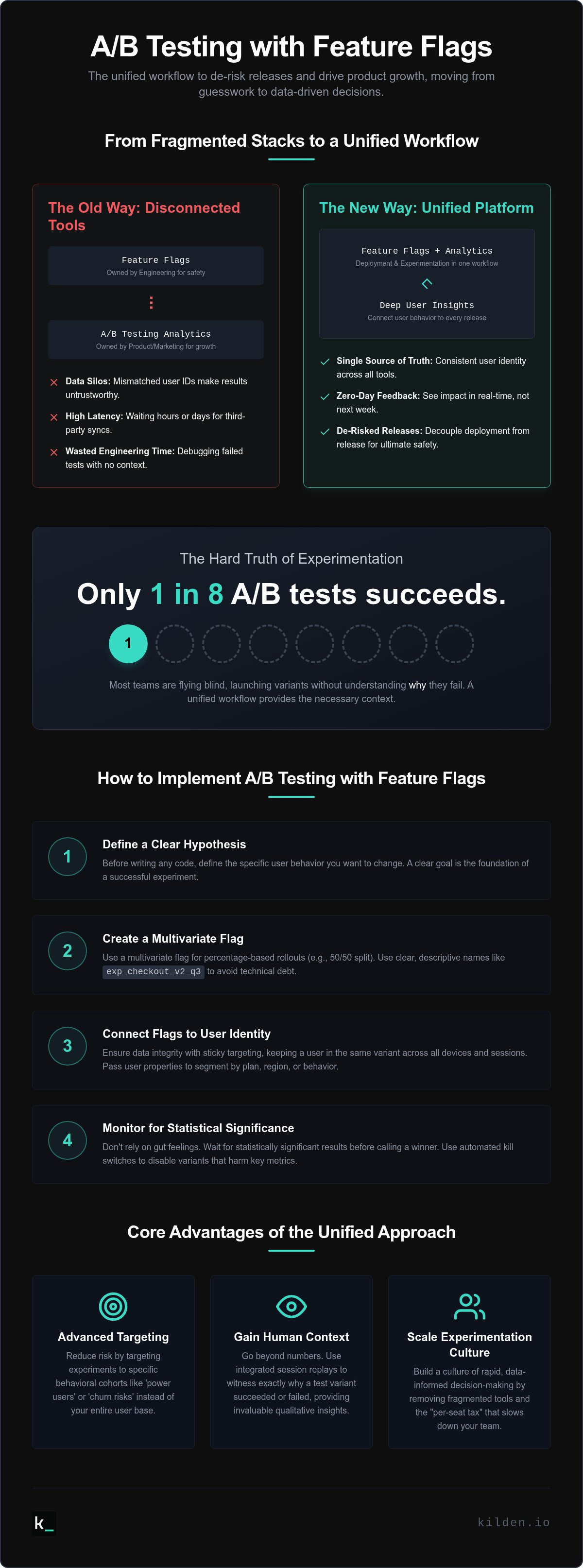
Only 1 in 8 A/B tests produces a statistically significant positive result. Most teams are flying blind. They burn through expensive per-seat licenses while their data sits trapped in disconnected silos. You launch a variant, see it fail, and have no idea why it happened. It's a waste of engineering time. Using a/b testing feature flags shouldn't feel like a compromise between risk management and data clarity. It should be the same workflow.
You already know that shipping faster is the only way to win. But speed shouldn't come with a black box analytics problem. This guide shows you how to execute high-velocity A/B tests using feature flags to de-risk every release and drive product growth. You'll learn to build a unified workflow that connects deployment to deep user insights. We're moving past fragmented stacks toward a reality where flags, analytics, and session replays live together. It's time to stop guessing and start deciding.
Key Takeaways
- Stop treating releases and experiments as separate events by merging flags and analytics into a single, high-velocity workflow.
- Follow a definitive framework for a/b testing feature flags to validate hypotheses without creating data silos or engineering bottlenecks.
- Reduce risk by targeting experiments to specific behavioral cohorts like power users or churn risks rather than blasting your entire audience.
- Gain human context for every data point by using integrated session replays to witness exactly why a test variant succeeded or failed.
- Build a scalable experimentation culture by removing fragmented toolsets and the "per-seat tax" that slows down decision-making.
Table of Contents
- Understanding A/B Testing vs. Feature Flags in 2026
- How to Implement A/B Testing with Feature Flags: A Step-by-Step Guide
- Advanced Targeting: Segmenting Your Experiments
- Beyond the Numbers: Using Session Replay for Context
- Scaling Experimentation: The Case for a Unified Platform
Understanding A/B Testing vs. Feature Flags in 2026
The line between deployment and experimentation has vanished. In the past, engineers owned feature flags for safety, while marketers owned A/B testing for growth. This separation was a mistake. Today, feature flags manage the "who" while A/B testing measures the "how." When you combine them, you gain the ability to control exactly who sees a feature and immediately see how they react. Traditional experimentation tools are losing ground because they exist outside the development workflow. They're an afterthought. Modern teams use a/b testing feature flags to make data-driven decisions part of the release itself.
The core advantage is decoupling. Deployment means the code is on the server. Release means the user can see it. By separating these two events, you eliminate the "big bang" release risk. You can verify a feature with 1% of your traffic for engineering stability before you ever care about conversion rates. This creates a clear distinction between Engineering Verification and Behavioral Analytics. One checks if the system is broken; the other checks if the feature is useful. You need both to ship with confidence.
The Problem with Fragmented Stacks
Most organizations struggle with data silos. Your flagging tool identifies users one way, but your analytics platform uses a different ID. This identity mismatch makes it impossible to trust your results. You end up exporting CSVs and wasting hours in spreadsheets trying to find the truth. There's also a massive latency issue. Waiting for third-party events to sync before you can see a test result is unacceptable in a high-velocity environment. Managing two different SDKs and two sets of user properties isn't just expensive; it's a technical debt trap that slows down every release.
Why 2026 Demands Unified Feature Management
Speed is the only competitive advantage that lasts. In 2026, waiting a week to see if a feature failed is a death sentence for product growth. Testing in production with zero-day feedback allows you to pivot before you waste a full sprint on the wrong idea. Product-Led Growth requires engineers and product managers to speak the same language. They need a single source of truth that shows both flag status and user behavior in one view. Unified feature management is the consolidation of control and insight into a single, seamless workflow. It treats every feature as an experiment by default. It puts the focus back on the humans using the software rather than the fragmented data points they leave behind.
How to Implement A/B Testing with Feature Flags: A Step-by-Step Guide
Every experiment starts with a clear hypothesis. Don't write a single line of code until you define the specific user behavior you want to change. If you're using a/b testing feature flags, you're setting up a control group and a variant directly in your deployment pipeline. This isn't a surface-level marketing overlay. It's a structural change. You define targeting rules based on real user attributes to ensure your sample is clean and your data is defensible. Connecting the flag to event-based analytics allows you to see the impact on your bottom line in real time.
Step 1: Creating the Multivariate Flag
Forget simple on/off toggles. For A/B testing, you need multivariate flags that support percentage-based rollouts. Start with a 50/50 split for a standard test, or use a multi-arm bandit approach if you need to find a winner quickly. Martin Fowler's breakdown of Feature Toggles explains that these "experiment toggles" must be short-lived. Use clear naming conventions like experiment_checkout_v2_august to avoid technical debt. If you name them poorly, you'll be hunting through your codebase for "test_1" six months from now. Keep it clean. Keep it descriptive.
Step 2: Connecting Flags to User Identity
Consistency is everything. If a user sees Variant A on their phone and Variant B on their laptop, your data is garbage. Use sticky targeting to ensure a user stays in the same variant across every session and device. You must pass user properties from your frontend to your flag management platform. This allows you to segment by plan type, region, or actual behavior. For larger teams, following feature flag best practices for enterprise is the only way to keep your identity logic from becoming a tangled mess. It's about maintaining a single source of truth for every user.
Step 3: Monitoring for Statistical Significance
Stop checking the dashboard every hour. Your gut feel is a liability. You need to wait for statistical significance before calling a winner. Set up automated kill switches that disable a variant if it causes a significant drop in core metrics. Use a sample size calculator before you start so you know exactly how long the test needs to run. When you unify your flags and analytics, you remove the guesswork from the process. You see the numbers. You see the behavior. You make the decision and move on to the next sprint.
Advanced Targeting: Segmenting Your Experiments
Testing on 100% of your traffic is a lazy strategy. For high-risk features, it is a recipe for a site-wide outage or a massive churn event. Smart teams use a/b testing feature flags to start small and move fast. They target power users first to gather qualitative feedback or focus on churn risks to test specific retention hooks. Geographic and device-based targeting allows for localized validation. You don't need a global launch to prove a hypothesis. You need a representative sample that minimizes your blast radius.
The Canary Release strategy is the gold standard for safety. You test with 1% of traffic to verify system stability before you ever consider an A/B split. This methodical approach is supported by academic research on feature flags, which highlights how flags have evolved from simple toggles into complex experimentation systems. It is about building layers of confidence. First, you prove the code doesn't break the build. Then, you prove the feature drives the right human behavior. Scaling only happens once the data earns it.
Building Dynamic User Segments
Static user lists are dead. You need real-time analytics to make targeting work. Effective segments update as users interact with your app. If a user hits a specific friction point, they should automatically enter a recovery experiment. Just as important is who you leave out. Always exclude internal team members and beta testers from your production A/B data. Mixing employee behavior with customer data ruins your statistical significance. Precise feature rollout management requires this level of surgical precision. It turns a risky launch into a controlled growth engine.
The Ethics of Experimentation
Don't break the core user experience for a test. If a variant adds friction to a critical path like checkout or login, kill it immediately. Respect your users' time. Experiment fatigue is a real problem in modern product development. If a single user is stuck in ten different concurrent tests, their experience becomes fragmented and confusing. Limit the number of experiments any one person sees at once. In 2026, transparency is a requirement. Ensure your data collection respects user privacy and follows modern standards. Experimentation should empower users, not exploit them for the sake of a conversion metric.
Beyond the Numbers: Using Session Replay for Context
Numbers are cold. They show you that Variant B failed, but they don't show you the frustration that caused it. You see a spike in bounce rates and assume the hypothesis was wrong. Often, the idea was solid but the execution was broken. When you combine a/b testing feature flags with session replay, you stop guessing. You see exactly where users got stuck. You witness the confusion. This qualitative layer turns a "failed" test into a roadmap for your next iteration. It's about finding the truth behind the data.
Integration is the key to clarity. By tagging session recordings with feature flag events, you can jump directly to the moment of friction. You might find that users are "rage clicking" a new call-to-action because it doesn't respond fast enough on mobile. Or perhaps they are hitting "dead clicks" on a graphic they think is a button. Session replay acts as the black box recorder for A/B tests, capturing the specific user behaviors that lead to a conversion or a churn event. It provides the human context that a spreadsheet never will.
Visualizing the Failure
Data silos make debugging impossible. If your analytics say there's a problem but your flag tool says everything is "on," you're stuck in the middle. You need to filter your session replay software by the specific variant assigned to the user. This reveals UI bugs that only appear in certain environments. Maybe Variant A looks perfect on Chrome but breaks on Safari. Without this visibility, you'd kill a winning feature just because of a CSS glitch. Don't let technical oversights dictate your product strategy. Fix the bug, don't just scrap the idea.
The Feedback Loop: Surveys and Flags
Sometimes you need to ask. If a user in Variant B spends three minutes on a page and then leaves, trigger an in-app survey. Ask them what was missing. By targeting these surveys specifically to users in a test variant, you gather sentiment that matches the behavior. You combine quantitative metrics with qualitative truth. This unified approach prevents "experiment fatigue" because you only ask the people who actually experienced the change. It's about respecting the human on the other side of the screen. To see this context in action, you can start capturing session replays with your feature flags today. Stop looking at flat lines and start watching your product through the eyes of your users.
Scaling Experimentation: The Case for a Unified Platform
Scaling shouldn't be a financial burden. Most vendors punish growth with per-seat licensing. This "per-seat tax" creates a gatekeeper culture where only a few authorized people can see the data. It's inefficient. It's also unnecessary. When you use a/b testing feature flags within a unified platform, you remove these artificial barriers. You don't need a massive team of data engineers to pipe events between three different tools. You need one source of truth that everyone can access without a price hike.
Fragmented stacks are inherently slow. Every new tool adds another SDK, another security review, and another potential point of failure. A single SDK that handles analytics, session replay, and feature flags reduces your technical footprint. It eliminates the "Data Tax" that comes from managed data engineering. You stop paying for the pipes and start paying for the insights. Kilden is the logical choice for teams that value speed over complexity. It's built for those who want to ship, not those who want to manage tool sprawl.
Eliminating the Integration Headache
Data discrepancies happen when identity systems don't match. If your flag tool sees User A and your analytics tool sees User B, your A/B test results are a fiction. A unified platform uses a single identity system. This prevents the identity mismatch problem that plagues fragmented setups. You move from idea to live test in minutes because the infrastructure is already there. Choosing the right feature flag tool isn't just about toggles; it's about the data ecosystem surrounding them. It's about ensuring the data you see is the truth.
Building a Culture of Testing
Experimentation shouldn't be a DevOps bottleneck. It should be a product superpower. When the platform is unified, non-technical product managers can launch tests without bothering engineers for custom tracking code. They can see the numbers, watch the session replays, and pivot based on reality. The financial benefit is just as important as the technical one. Volume-based pricing allows everyone in your organization to participate in the growth process. You build a culture of truth, not a culture of permission. It's time to stop guessing and start building with confidence. Stop toggling in the dark; see how Kilden unifies flags and analytics.
Ship with Certainty, Not Guesswork
The era of fragmented toolsets is over. You can't afford to wait for data to sync between platforms while your users churn. Success in 2026 requires more than just toggling features on and off. You need to verify every release with real-world behavior and human context. By consolidating your workflow, you eliminate the identity mismatch and technical debt that slow down your engineering team. It's about finding relief through simplification and clarity.
The most effective way to scale is to implement a/b testing feature flags on a platform that values transparency over per-seat licensing. You gain the power to see the conversion numbers. You see the exact user friction behind them through integrated session replays. This unified approach turns every deployment into a high-velocity learning opportunity. It's time to stop managing complex tool sprawl and start driving product growth with a single source of truth. You deserve a workflow that respects your time and your data.
Start testing smarter with Kilden’s unified feature flag and analytics platform.
Build faster. Test deeper. Keep shipping with confidence.
Frequently Asked Questions
Is it better to use a dedicated A/B testing tool or feature flags?
Feature flags are superior for modern product teams because they integrate directly with your deployment pipeline. Dedicated marketing tools often create data silos and cause significant latency. Using a/b testing feature flags allows you to control the release and measure the impact in one unified workflow. You avoid the identity mismatch that happens when your analytics don't talk to your flagging system. It's about engineering efficiency.
How do feature flags help with A/B testing in production?
They allow you to test in production without risking a site-wide failure. You can route a small percentage of traffic to a new variant while the rest of the users stay on the stable version. This decouples code deployment from feature release. If the variant causes an error, you flip the toggle and the problem vanishes instantly. It's the safest way to gather real-world data from actual humans.
What is the difference between a feature rollout and an A/B test?
A rollout focuses on engineering safety while an A/B test focuses on behavioral impact. Rollouts use flags to gradually increase traffic from 0% to 100% to monitor for bugs or server load. A/B testing uses those same flags to compare two different versions of a feature to see which one drives more growth. You use the same infrastructure for two different goals. Both are essential for shipping with confidence.
Can I run multiple A/B tests concurrently with feature flags?
Yes, provided you manage your user segments carefully. Running multiple tests can lead to experiment fatigue if a single user is stuck in too many variants. You should use a platform that handles mutual exclusion. This ensures that a user in Test A isn't also being influenced by a conflicting change in Test B. This keeps your data clean and your insights reliable. Don't let overlapping tests ruin your truth.
How do I handle statistical significance in feature flag experiments?
Use built-in analytics that calculate significance for you in real time. Never stop a test early based on a gut feel or a temporary spike in the numbers. You need a sufficient sample size to ensure the result isn't just noise. Unified platforms make this easier by connecting flag events directly to your conversion metrics. This eliminates the need for manual CSV exports and spreadsheet math. Trust the math, not the feeling.
Does using feature flags for A/B testing impact site performance?
The impact is negligible if you use a performant SDK. Modern platforms evaluate flag logic locally on the client or at the edge. There is no round-trip delay to a central server every time a user loads a page. You avoid the flicker effect common in traditional client-side A/B testing tools. It's a faster, smoother experience for the user. Performance is a feature, and your testing tool shouldn't break it.
What happens if a feature flag fails during an A/B test?
The system should always have a default state defined in your code. If the flag management service is unreachable, the SDK falls back to this safe default. This ensures your app never breaks due to a configuration error. During a/b testing feature flags, you can also use a kill switch to disable a failing variant manually. You don't need a full code redeploy to stop the bleeding. Safety is built in.
How do I manage technical debt created by A/B test feature flags?
Treat flags as temporary code. Once a winner is declared, schedule a task to remove the flag and the losing variant's code from your repository. Leaving experiment toggles in your codebase indefinitely creates a tangled mess that's hard to maintain. Effective teams make flag cleanup a standard part of their definition of done. It's about maintaining a clean, lean architecture. Don't let your experiments become permanent technical debt.