Product-Led Growth Tools in 2026: From Fragmented Stacks to Unified Ecosystems

on this page ▾
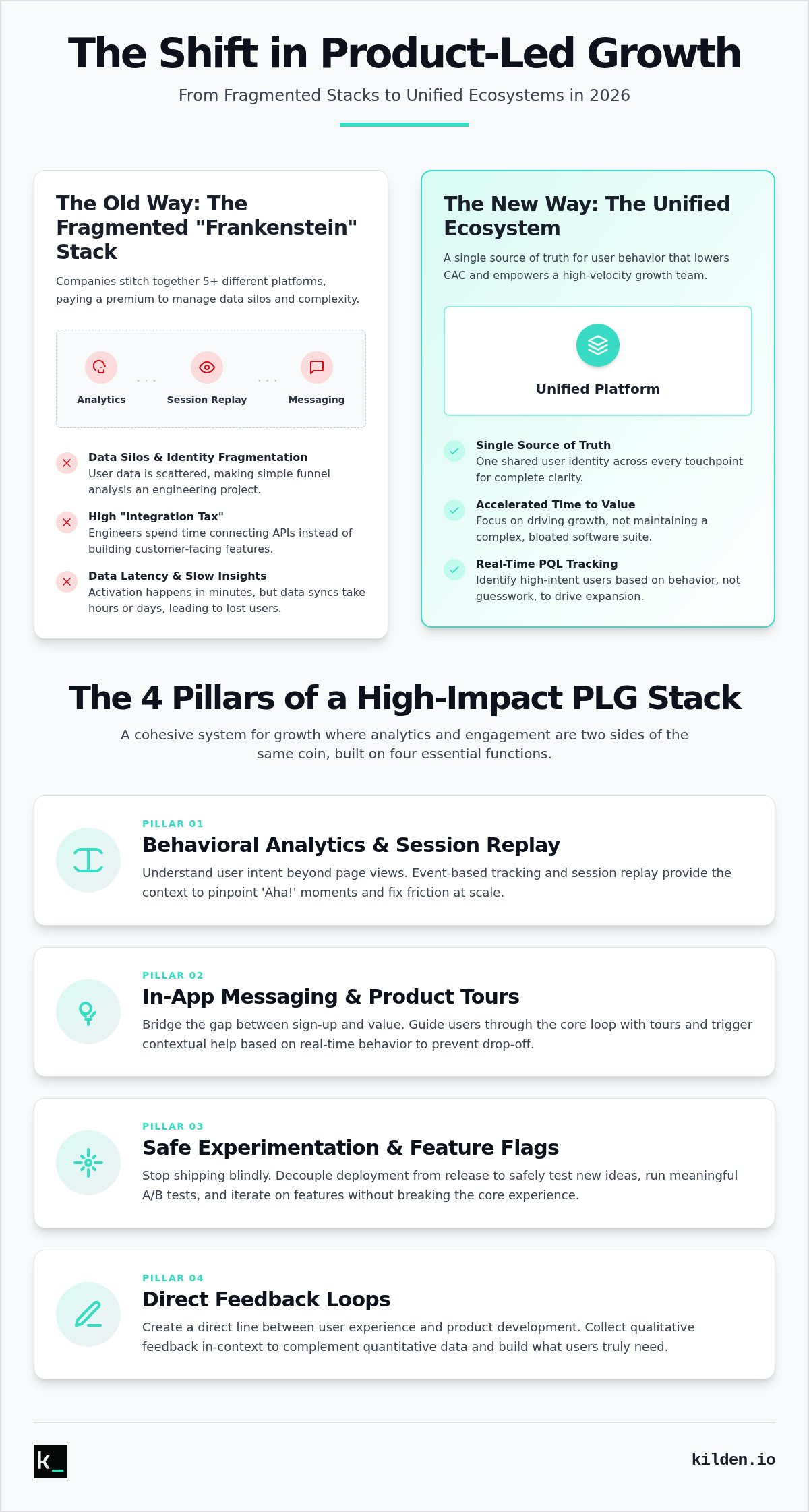
Your current growth stack is a tax on your team's velocity. Most companies stitch together five different platforms; they pay a premium for the privilege of managing data silos. You're likely tired of the complexity. You want to see a funnel without hiring a data engineer. You're right to be frustrated. The industry has spent years selling you fragmented product-led growth tools that don't talk to each other. It's time to stop the bleeding.
We agree that the status quo is broken. You shouldn't be penalized with high costs just because you want your team to collaborate. You shouldn't need a complex engineering project just to understand why users aren't finishing a tour. This article promises to help you stop fighting your own data. You'll discover the lean, unified toolset required to drive sustainable product-led growth in 2026. We're moving away from bloated, disconnected software toward ecosystems that prioritize truth and clarity. We'll preview the shift from fragmented stacks to unified systems that lower your CAC and empower a high-velocity growth team.
Key Takeaways
- Understand why unified ecosystems are replacing fragmented stacks as the default enterprise go-to-market motion for 2026.
- Identify the hidden costs of identity fragmentation and learn why you shouldn't need a data scientist to build a simple funnel.
- Evaluate product-led growth tools by prioritizing Time to Value and choosing unified codebases over suites of acquired software.
- Learn how to eliminate the per-seat tax and data silos to create a single source of truth for user behavior.
- Discover the four pillars of a high-impact stack that drives acquisition, activation, and expansion without the friction.
Table of Contents
- What Are Product-Led Growth Tools in 2026?
- The 4 Essential Pillars of a High-Impact PLG Stack
- The Hidden Costs of Fragmented PLG Tools
- How to Evaluate and Select Your PLG Ecosystem
- Kilden: The Unified Alternative for High-Velocity Teams
What Are Product-Led Growth Tools in 2026?
In 2026, product-led growth tools are the infrastructure that turns your software into its own best salesperson. This isn't just about a "free trial" button. It's a technical ecosystem designed to make the product the primary engine for acquisition, activation, and expansion. The goal is simple. Deliver value first. Ask for the credit card later. If your software doesn't prove its worth immediately, your marketing budget is essentially a donation to your competitors.
The industry has matured. We've moved past the era where PLG was a scrappy startup strategy. It's now the default enterprise go-to-market motion. Marketing jargon has been replaced by pure utility. Users don't care about your "innovative synergy." They care if your tool solves their problem in under sixty seconds. If it doesn't, they'll find a solution that does. This shift requires a toolset that prioritizes clarity over complexity.
The Evolution of PLG Tooling
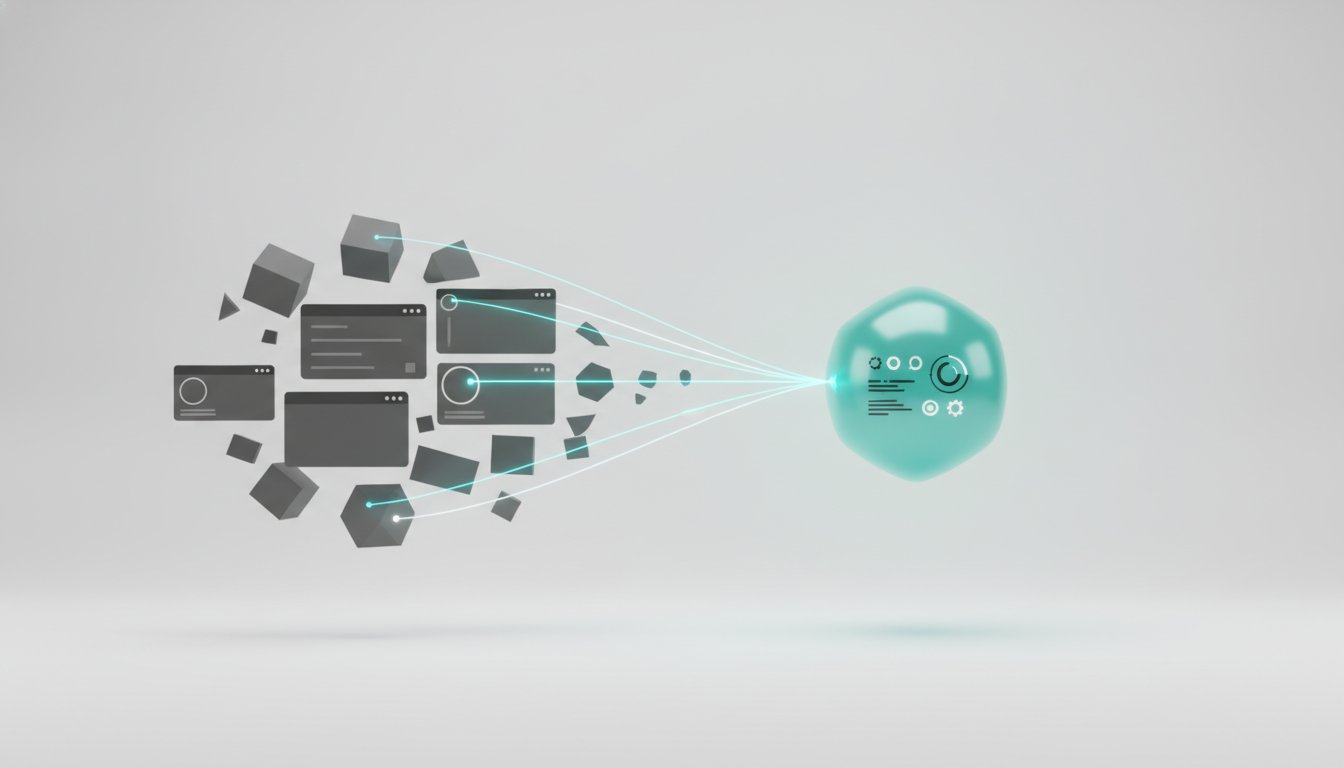
The years between 2020 and 2024 were defined by fragmentation. You had one tool for analytics, another for session replays, and a third for in-app tours. This created a "Frankenstein" stack. It was expensive. It was difficult to maintain. By 2026, the market has shifted toward unified ecosystems. These systems share a single user identity across every touchpoint. No more mapping IDs between three different platforms just to see a funnel.
We're also seeing the death of "Unlimited Freemium." Giving away everything for free is a fast way to go out of business. Modern tools focus on Product-Qualified Lead (PQL) tracking. They identify high-intent users based on real behavioral data. You don't guess who might buy. You see exactly who is getting value and target them with precision. The product does the qualifying so your team doesn't have to.
Why Your Current Stack Might Be Sabotaging You
Data latency is a silent killer. If your analytics tool takes 24 hours to sync with your engagement platform, you've already lost the user. Activation happens in minutes, not days. Waiting for data to "refresh" is a luxury you can't afford. This is the "Integration Tax." It's the time your engineers spend connecting APIs instead of building the features your customers actually want. Every hour spent on data engineering is an hour stolen from product innovation.
Product-Led Growth is a business strategy where the product itself acts as the primary sales channel by directly facilitating user acquisition and retention. If your tools don't talk to each other, your product can't sell itself. You're left fighting your own stack instead of growing your business. It's time to stop the technical sprawl and focus on what actually moves the needle: user value.
The 4 Essential Pillars of a High-Impact PLG Stack
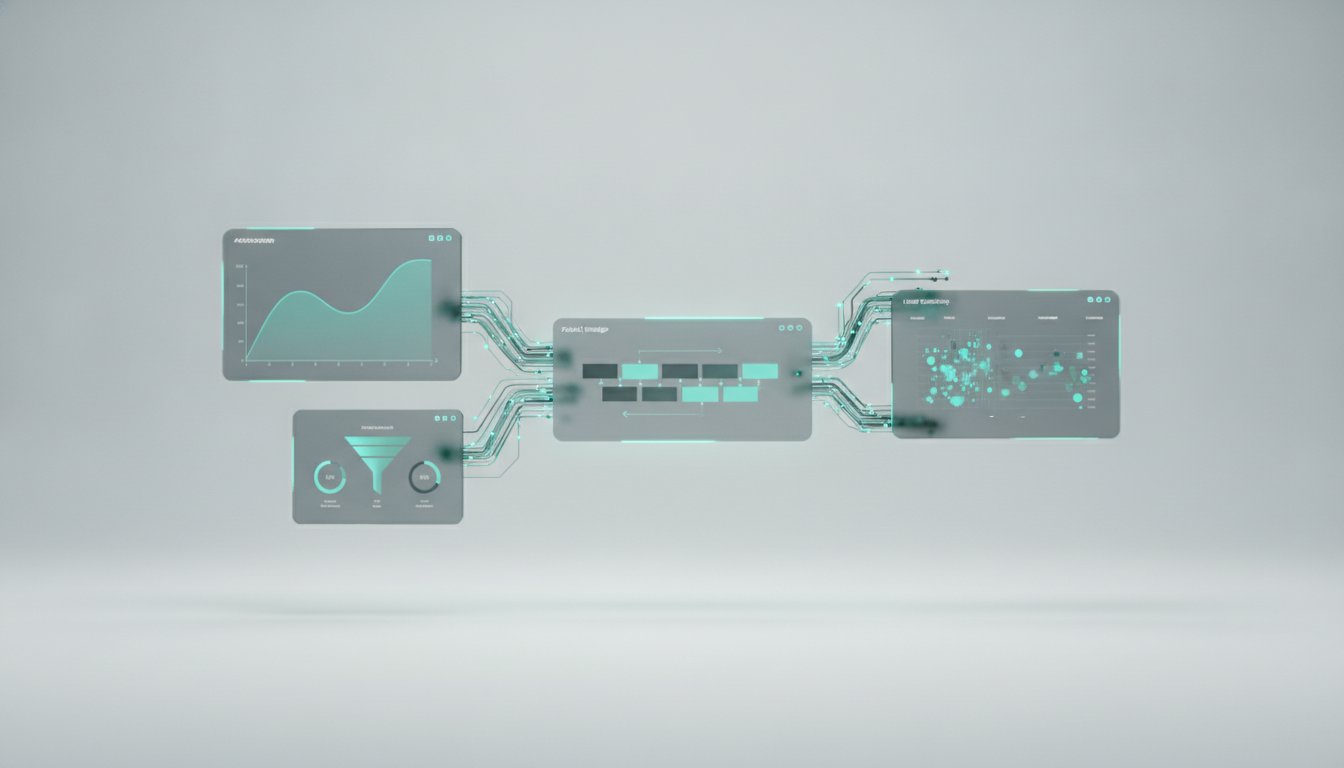
Building a growth engine requires more than just a list of product-led growth tools. You need a cohesive system. Most teams fail because they treat analytics and engagement as separate problems. They aren't. They are two sides of the same coin. Complexity is the enemy of growth. When your tools don't talk, your team spends more time debugging integrations than talking to customers. A high-impact stack rests on four essential pillars: deep behavioral analytics, frictionless engagement, safe experimentation, and direct feedback loops.
Behavioral Analytics and Session Replay
Page views are dead. In 2026, you need event-based tracking to understand user intent. Session replay software acts as the ultimate context builder, showing you exactly where a user's cursor paused in confusion. This isn't just data; it's UX research at scale. By using cohort analysis, you can pinpoint the specific 'Aha! moments' that lead to long-term retention. Seeing the struggle is the first step toward fixing it.
In-App Messaging and Product Tours
Onboarding is where most growth dies. Effective product tour software for onboarding bridges the gap between 'Sign Up' and 'Value.' It guides users through the core loop without heavy-handed intervention. Combine this with no-code in-app messaging to trigger help based on real-time behavior. If a user stalls, show them the way. For expansion, in-app banner tools remain the most underrated lever for driving upgrades without interrupting the natural workflow.
Feature Flags and Experimentation
Stop shipping blindly. Feature flags allow you to decouple deployment from release, letting you iterate on new ideas without breaking the core experience. You can run A/B tests that focus on the bottom line rather than vanity metrics. Feature flags reduce development risk in PLG motions by providing an instant kill switch for any feature that negatively impacts user behavior or system performance. It's about moving fast without the fear of a catastrophic rollback.
Quantitative data is only half the story. You need direct feedback loops to capture the 'Why' behind the numbers. Don't wait for a quarterly review to find out why users are leaving. In-app surveys allow you to collect qualitative insights at the exact moment of interaction. This creates a continuous improvement cycle that keeps your product aligned with user needs. A unified approach ensures these pillars support each other instead of competing for attention. See how Kilden brings these functions into a single codebase.
The Hidden Costs of Fragmented PLG Tools
Buying a separate tool for every task feels logical at first. It isn't. It's a recipe for technical debt. Most product-led growth tools are sold as standalone solutions. When you buy five of them, you aren't building a stack; you're building a maze. This fragmentation creates hidden costs that drain your budget and your team's energy. You end up fighting your tools instead of building your product. Growth becomes a series of engineering tickets rather than a strategic advantage.
Identity fragmentation is the first major hurdle. A single user might have three different IDs across your analytics, messaging, and survey tools. Mapping these together is a nightmare. It leads to broken experiences where a user gets an onboarding email for a feature they've already mastered. This is why data silos kill in-app messaging engagement. If your messaging tool doesn't know what your analytics tool saw ten seconds ago, your engagement is just noise. You lose the "human" element of the data because the user is just a set of disconnected rows in various databases.
The Reality of Managed Data Engineering
The "Data Engineering Trap" is real. You shouldn't need a data scientist just to build a simple conversion funnel. Many vendors promise "out of the box" integrations. In reality, these often require custom ETL pipelines and constant maintenance. You spend weeks ensuring data flows correctly between tools. Every time an API changes or a schema updates, your stack breaks. This fragmentation leads to analysis paralysis. Product managers stop asking questions because getting answers is too much work. Growth slows down because the friction of the stack is higher than the value of the insights. You're paying for software that your engineers are too busy fixing to actually use.
The Collaboration Killer: Per-Seat Licensing
Traditional licensing models punish collaboration. Per-seat pricing forces you to choose who gets to see the data. This leads to information hoarding. When only three people have access to the analytics dashboard, the rest of the team is flying blind. Decisions start happening in silos based on gut feelings rather than shared truth. Every member of your team belongs in the data. Product, marketing, and success teams need to see the same user journey to be effective. Transitioning away from seat-based models toward usage-based or flat-rate structures is essential for true scale. It ensures that growth is a collective effort, not a restricted privilege. You shouldn't be penalized for being a collaborative organization.
How to Evaluate and Select Your PLG Ecosystem
Stop chasing features. Start auditing architecture. Selecting product-led growth tools isn't about finding the longest list of capabilities. It's about finding the least amount of friction. Most teams get blinded by shiny dashboards and forget to check the plumbing. If your tools require a dedicated engineer to keep them synced, they aren't helping you grow. They're slowing you down. Focus on Time to Value (TTV). If you can't go from 'Sign Up' to 'First Insight' in under an hour, the tool is too complex for a high-velocity team.
Distinguish between an acquired suite and a unified codebase. Many legacy vendors buy smaller companies and tape them together. The UI looks the same, but the underlying data structures are different. This creates Franken-stacks that look unified but act fragmented. You want a single, unified codebase where every feature is built on the same foundation. This ensures that a user ID in your analytics is identical to the one in your messenger. Complexity is a choice. Efficiency is a design.
The Unified Identity Test
Architecture matters more than UI. Perform the unified identity test. Can you trigger an in-app message based on a session replay event instantly? If the answer involves an ETL pipeline, you've failed. Your feature flag state must inform your analytics dashboard without manual mapping. Testing for real-time data flow between engagement and insight is the only way to ensure a single source of truth. A fragmented stack gives you multiple versions of the truth. A unified ecosystem gives you the facts.
Beyond the Buzzwords: Essential Feature Checklist
Ignore the marketing fluff. Your must-have list is shorter than you think. You need event tracking, session recordings, and in-app surveys. These provide the 'What' and the 'Why.' You also need feature flags that don't require a code deploy to toggle. Waiting for a sprint cycle to kill a failing experiment isn't agility. It's a bottleneck. This is the core value of a modern product engagement platform. It bridges the gap between seeing a problem and acting on it.
Scalability isn't just about handling traffic. It's about your pricing model. Avoid tools that penalize collaboration with per-seat costs. Your developer experience (DevEx) is equally critical. Is the SDK lightweight? Is the documentation written for humans? If implementation takes months, your growth strategy will be dead before the first event is tracked. Choose a platform that respects your engineering time. Build your unified growth stack with Kilden.
Kilden: The Unified Alternative for High-Velocity Teams
Stop fighting five different vendors. We built Kilden because the industry standard for product-led growth tools is broken. You shouldn't have to choose between deep analytics and effective engagement. You shouldn't have to spend your weekends mapping user IDs across disconnected platforms. We combined these functions into a single, cohesive ecosystem. This isn't a collection of acquired tools taped together. It's a unified codebase designed for teams that value truth over technical sprawl.
Kilden provides unified product analytics and engagement on one platform. This means session replay, feature flags, and event tracking live alongside your messenger and product tours. One user. One identity. Zero integration headaches. When you see a user struggle in a session replay, you can trigger a tour or a messenger prompt instantly. There is no data latency. There are no silos. There is only the direct path to user value.
We've also eliminated the per-seat tax. Most platforms penalize you for being collaborative. They charge you more as your team grows. We don't. Everyone on your team belongs in the data. Whether you're a junior marketer or a senior engineer, you need access to the truth. Removing these financial barriers ensures that growth becomes a shared responsibility rather than a restricted privilege. Clarity should be accessible to everyone.
A Lean Approach to Product Growth
Managed data engineering is a waste of your engineering resources. Kilden doesn't require it. You get a single, lightweight SDK that powers your entire growth motion. You can deploy in-app banners and engagement campaigns in minutes. You don't need a sprint cycle. You don't need a data scientist to build a funnel. This empowers the humans behind the product to act on their instincts immediately. It turns insights into action without the typical bureaucratic friction of a fragmented stack.
Getting Started with a Unified Stack
Migration shouldn't be a months-long project. It should be a transition toward efficiency. The path from fragmented product-led growth tools to a unified stack is straightforward. You can identify exactly why users drop off in your sign-up funnel within the first hour of installation. No more guessing. No more cross-referencing dashboards. You see the friction, you deploy the fix, and you measure the impact in real time. Kilden is the logical choice for modern PLG teams who value velocity over complexity.
The Future of High-Velocity Growth
The era of the Frankenstein stack is ending. You've seen the hidden costs of tool sprawl. You've felt the friction of mapping user IDs across five different dashboards. In 2026, high-velocity teams don't have time for managed data engineering. They need a single source of truth that combines behavioral insights with immediate action. Efficiency isn't a luxury. It's a requirement for survival in a market that demands faster time to value. You can't lead the market if you're lagging behind your own data syncs.
Choosing the right product-led growth tools means prioritizing structural integrity over a long list of disconnected features. You need a system where session replays, feature flags, and in-app messaging share a single identity. This isn't just about better software. It's about empowering every human on your team to move at the speed of your users. Stop fighting your data. Start using it to drive sustainable expansion. You have the blueprint for a leaner, more effective growth motion. Now, execute it.
Build your PLG ecosystem with Kilden; no per-seat licensing, no data silos.
Frequently Asked Questions
What are the most important metrics to track with PLG tools?
Focus on Time to Value (TTV), Activation Rate, and Product-Qualified Leads (PQLs). You need to know exactly how long it takes for a user to reach their first "Aha!" moment. Stop tracking vanity metrics like total registrations. Measure the specific event-based actions that correlate with long term retention and expansion. If you can't see the path from sign up to value, you can't optimize it.
Can I use PLG tools if I have a sales-led motion?
Yes. This is often called Product-Led Sales. Your sales team uses behavioral data to identify high-intent accounts that are already finding value in the product. Instead of cold calling, they reach out when a user hits a specific usage threshold. It makes your sales process more efficient and much more human. The product does the qualifying so the humans can focus on closing.
Why is session replay important for product-led growth?
Analytics tell you that a user dropped off, but session replay shows you why. You might see a user struggle with a confusing button or a broken form field in real time. It provides the qualitative context that numbers lack. By watching how real humans interact with your software, you can eliminate friction points that are invisible in a standard funnel report.
How do feature flags help with user activation?
Feature flags allow you to test different onboarding flows without a full code deploy. You can roll out a new feature to a small cohort and measure its impact on activation before a global release. If the data shows a negative trend, you toggle it off instantly. This high-velocity experimentation ensures that only the most effective experiences reach your entire user base.
What is the difference between an analytics tool and a PLG ecosystem?
An analytics tool records what happened in the past. A product-led growth tools ecosystem connects those insights to immediate action. It allows you to see a specific user behavior and trigger an in-app message or a product tour within the same platform. It eliminates the delay between insight and execution by keeping everything under a single user identity.
Is per-seat licensing common in product-led growth tools?
It is common in legacy platforms, but it's a major bottleneck for growth. Restricting access to data creates information silos and prevents your team from collaborating. Modern ecosystems prefer usage-based or flat-rate models. Every member of your product, marketing, and success teams should have access to the same truth without your budget being penalized for their participation.
How do in-app surveys contribute to product-led growth?
In-app surveys capture the user's sentiment at the exact moment of interaction. Don't wait for an email survey that gets ignored. Ask for feedback while the experience is fresh. This real-time qualitative data helps you validate your product roadmap and ensures you are building features that users actually want, rather than what you assume they need.
Can PLG tools help reduce customer churn?
Yes, by identifying at-risk users before they leave. Unified product-led growth tools monitor for a drop in core activity. When a user stops performing the actions that lead to value, you can trigger a targeted re-engagement campaign. Acting on these early warning signs allows you to save the relationship while the user is still active, rather than trying to win them back after they've already canceled.