Data Silos: The Cost of Fragmented Identity in 2026


on this page ▾
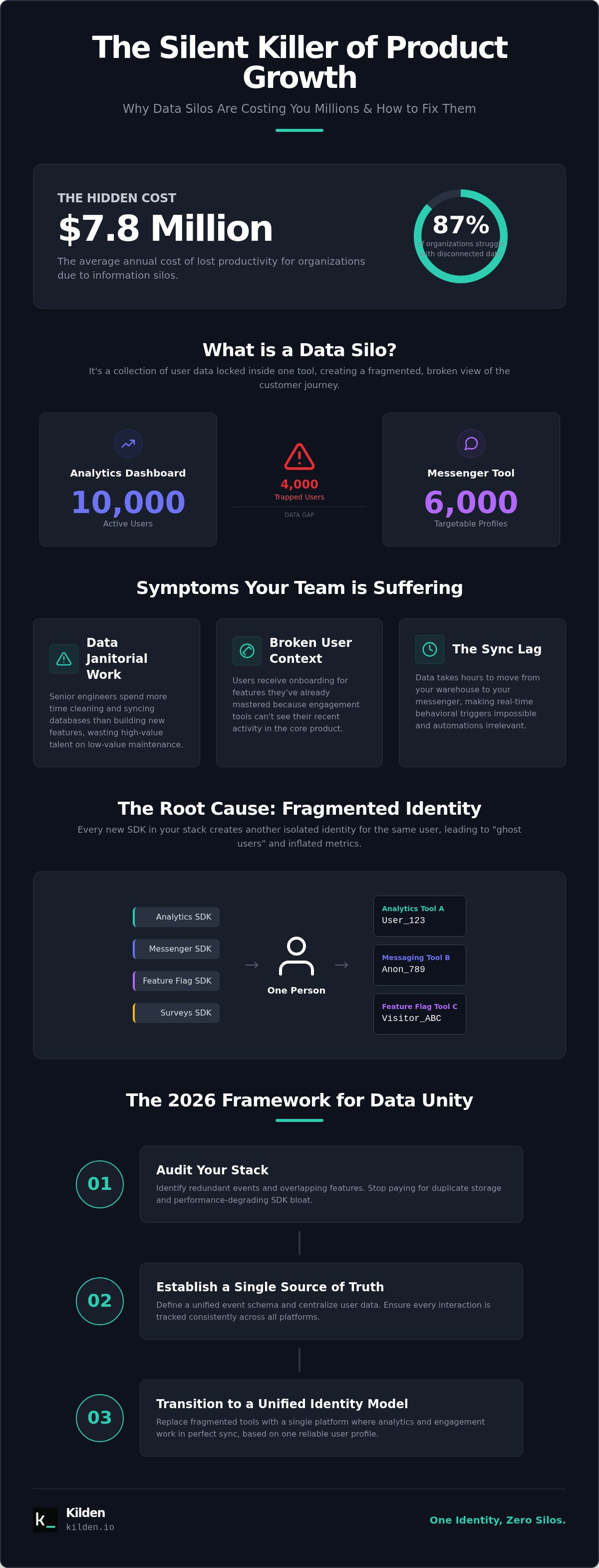
Information silos cost organizations an average of $7.8 million annually in lost productivity. This is not just a corporate buzzword; it is a direct drain on your engineering resources and your product velocity. You are likely part of the 87% of organizations currently struggling with disconnected data sources. When data silos product analytics efforts fail, your user experience feels broken. You end up sending "dead" messages to users who already converted because your messenger tool is hours behind your actual database events. It is embarrassing, and it is avoidable.
You want a single, reliable view of the user journey without the constant "Tool Tax" of maintaining five different SDKs. We agree that fragmented data is the silent killer of product growth. This article explains why fragmented identity is the root cause of your technical debt and how to unify your analytics and engagement tools into a single source of truth. You will learn how to trigger messages based on real-time behavior, reduce engineering tickets, and finally see your users as humans instead of disjointed data points.
Key Takeaways
- Stop guessing why your "Active User" count doesn't match your messaging audience. Learn why trapped information creates a broken view of your product journey.
- Solve the "Identity Crisis" at the source. Discover why data silos product analytics problems stem from multiple SDKs assigning different IDs to the same human.
- Eliminate the "Tool Tax" and technical debt. Stop paying for duplicate storage and overlapping features that slow down your engineering team and delay campaigns.
- Implement a 2026 framework for data unity. Audit your stack to find redundant events and establish a single, reliable source of truth for every user interaction.
- Transition to a unified identity model. See how replacing fragmented tools with a single platform ensures your analytics and engagement suites work in perfect sync.
Table of Contents
- What are Data Silos in Product Analytics?
- The Root Cause: The Fragmented Identity Crisis
- The True Cost of Data Silos (The "Tool Tax")
- How to Eliminate Data Silos: A 2026 Framework
- The Kilden Approach: One Identity, Zero Silos
What are Data Silos in Product Analytics?
Imagine checking your analytics dashboard and seeing 10,000 active users. You open your messenger tool to send a feature announcement, but it only shows 6,000 targetable profiles. Where did those 4,000 people go? They are trapped. A data silo is essentially a collection of user information locked inside one tool, completely inaccessible to the rest of your stack. Data silos product analytics failures serve as the primary barrier to product-led growth in 2026 by trapping the insights needed to deliver a cohesive user experience.
These silos are often invisible. They don't announce themselves with an error message or a broken API. Instead, they hide in the background until a marketing campaign fails or a product launch stalls because the data is not ready. To understand the foundation of this problem, we must first answer a basic question: What are Data Silos? At their core, they represent a failure of systems to communicate, leading to a fragmented view of the human experience. In the world of data silos product analytics, this friction is what prevents you from seeing your users clearly.
The 2026 Context: Why Silos are Multiplying
The tech industry fell into the "Best-of-Breed" trap. We were told to buy five specialized tools for five different problems. We bought one for session replays, another for feature flags, and a third for in-app surveys. The result? Five disconnected realities. Each tool uses its own SDK and creates its own version of the user journey. The rise of micro-services has only worsened this fragmentation, making it nearly impossible to map a single user's path through a complex application. Traditional product analytics platforms often fail here. They provide plenty of charts but lack the native plumbing to bridge the gap with engagement tools in real time.
Signs Your Product Team is Suffering from Siloed Data
You don't need a formal audit to know if your data is broken. The symptoms are visible in your daily workflow. If your team relies on manual CSV exports as their primary integration strategy, you have a silo problem. You are likely also feeling these pains:
- Data Janitorial Work: Your senior engineers spend more time cleaning and syncing databases than they do building new features. It is a waste of high-value talent on low-value maintenance.
- Broken User Context: Users receive onboarding tours for features they already mastered months ago. This happens because the engagement tool has not seen their recent activity in the core product.
- The Sync Lag: You wait hours for data to move from your warehouse to your messenger tool. This delay makes real-time behavior triggers impossible, turning your "automated" engagement into a series of late, irrelevant interruptions.
This fragmentation isn't just a technical annoyance. It is a fundamental breakdown in how you understand your users. When your behavioral data is disjointed, your product feels disjointed to the person using it.
The Root Cause: The Fragmented Identity Crisis
Your stack is suffering from a split personality. Every time you drop a new SDK into your codebase, you aren't just adding a feature. You are creating a new, isolated identity for your users. Analytics Tool A sees "User_123". Messaging Tool B sees "Anon_789". This is the core of the identity crisis. When data silos product analytics tools fail to agree on who a person is, your entire growth strategy crumbles. You end up with "Ghost Users", which are inflated metrics where one person appears as three different records across your stack. It makes your acquisition costs look lower than they are and your retention look like a disaster.
Many teams try to fix this by "stitching" data in a warehouse. It's a reactive, expensive band-aid. By the time your SQL query runs and identifies the match, the user has already closed their browser. You're left chasing ghosts. This lag is a major part of the negative impact of data silos, as decision-makers rely on stale, fragmented snapshots instead of a living user journey. If you want to stop the bleeding, you need to unify your identity layer at the point of collection.
SDK Bloat and Performance Degradation
Running five different tracking scripts on your frontend is a recipe for performance degradation. Each script adds weight, increasing time-to-value for new users during that critical first onboarding session. Every millisecond of delay increases the chance of bounce. While session replay software provides context that silos often strip away, adding it as yet another disconnected script just compounds the bloat. You shouldn't have to trade site speed for user insight.
The Failure of Traditional ETL Processes
Traditional ETL processes are too slow for 2026. Extract, Transform, Load is built for "Data at Rest"; it's for historical reporting for the board meeting. But product growth requires "Data in Motion". Your in-app messaging platform needs a direct line to behavioral data. If there's a 30-minute delay between a user hitting a friction point and your support banner appearing, you've already lost them. Real-time engagement is impossible when your data has to travel through a warehouse first. Silos don't just store data differently. They kill the timing that makes data useful.
The True Cost of Data Silos (The "Tool Tax")
Data silos aren't just a technical hurdle. They are a massive financial drain. Information silos cost organizations an average of $7.8 million annually in lost productivity according to Speakwise research from May 2026. This is the "Tool Tax" in action. You are paying for duplicate storage across four or five different vendors. You are paying for overlapping features because your analytics tool and your messenger tool both claim to do "segmentation." It is redundant. It is expensive. It is a waste of capital that should be going toward product innovation.
The financial leak is only the beginning. The opportunity cost of data silos product analytics failure is even higher. Campaigns stay in draft mode because the data "isn't ready." Product teams miss critical windows to pivot because they can't trust their own dashboards. When your "Active User" count differs across tools, stakeholders lose faith. Trust vanishes. PMs and engineers then spend their weekends doing soul-crushing data reconciliation instead of building value. Bad data quality costs organizations an average of $12.9 million annually according to SR analytics. This human cost is the silent killer of high-performing teams.
Calculating the Tool Tax in 2026
Hidden fees are the hallmark of legacy stacks. As you scale, product analytics pricing becomes a trap. You pay per event in one tool and per profile in another. To bridge these gaps, many companies feel forced into Managed Data Engineering. They hire consultants to build fragile pipelines that break every time an API updates. It is a cycle of unnecessary complexity. The only logical exit is to replace multiple product tools with one platform. Consolidating your stack reclaims your budget and your sanity.
How Silos Damage the User Experience
Your users don't care about your backend architecture. They only care when it fails them. We call this the "Broken Journey" effect. Imagine messaging a user with a "Welcome" discount 20 minutes after they already made a full-price purchase. It feels amateur. It happens because your messenger tool is siloed from your checkout events. This fragmentation is the primary cause of onboarding friction. Even the most advanced product tour software for onboarding fails if it doesn't have real-time access to user behavior. Silos turn your product into a series of disjointed rooms instead of a seamless home. You cannot build a human-centric experience on top of fragmented data.
How to Eliminate Data Silos: A 2026 Framework
Stop building bridges between broken islands. Most teams try to fix data fragmentation by adding more "integrations." They connect Tool A to Tool B via an API and hope the sync doesn't lag. It always lags. To fix data silos product analytics issues, you must move from a strategy of integration to a strategy of unification. You don't need better pipelines. You need a single foundation where identity and behavior live in the same room. This framework moves you away from the "Tool Tax" and toward a streamlined, high-velocity reality.
Auditing Your Data Stack
Open your frontend codebase. Look at your primary conversion buttons. If you see four different tracking calls for a single "Subscribe" click, you have a leak. Map your user journey against your current tool sprawl. Identify where the same event is being captured multiple times by different SDKs. This redundancy is the primary source of data discrepancies. Follow the "One Event, One Source" rule. If an action happens once, it should be recorded once into a single behavioral stream. Anything else is just creating technical debt for your future self.
Moving from Siloed Tools to a Unified Platform
Understand the technical difference between "Integrated" and "Unified." Integrated tools are separate databases trying to talk to each other through a narrow pipe. Unified tools share a single database from the start. This is not a semantic nuance. It is the difference between a 20-minute data delay and a 20-millisecond response. Unified product analytics and engagement is the only way to achieve real-time personalization. If your analytics tool doesn't natively talk to your messenger, you will always be reactive.
Evaluate your stack based on its ability to handle identity stitching at the point of collection. You should not have to run a SQL job to figure out that "User_A" in your analytics is the same person as "User_B" in your surveys. A unified platform assigns one identity for every interaction. This eliminates "Ghost Users" and ensures your metrics are grounded in reality. It is time to stop managing a mess of APIs and start managing your product. Unify your identity and analytics with Kilden to reclaim your engineering hours and your user context.
Consolidating Your SDKs
Technical agility requires a lean frontend. Every SDK you remove improves your site speed and reduces the surface area for tracking errors. Consolidate your behavioral tracking into a single SDK that feeds your analytics, your session replays, and your engagement triggers simultaneously. This ensures that when a user completes a goal, every part of your system knows it instantly. No more "dead" messages. No more reconciling spreadsheets. Just one stream of truth for your entire team.
The Kilden Approach: One Identity, Zero Silos
Most vendors tell you to fix data silos by buying more software. They suggest a Customer Data Platform (CDP) or a complex Data Lake to "stitch" everything back together. It is a backwards strategy. You shouldn't have to hire a team of consultants to tell you who your users are. Kilden rejects the bloat. We replace the fragmented stack with a single, high-velocity platform designed for clarity. By unifying your behavioral data at the source, we solve the data silos product analytics crisis before it starts.
One Identity is our core philosophy. Your analytics, session replays, and feature flags all see the same human being in real time. There is no "Identity Stitching" required because the data was never separated in the first place. This architecture enables Zero Latency actions. You can trigger a messenger for user feedback the exact millisecond a user drops off a critical conversion funnel. No waiting for warehouse syncs. No stale data. Just immediate, relevant engagement.
We also eliminate the "Tool Tax" entirely. Kilden operates on a flat rate model with no per-seat licensing. We don't believe in taxing your team's growth or forcing you into expensive managed data engineering contracts. You get a single source of truth that works out of the box, letting you focus on the user instead of the plumbing.
Unified Analytics and Engagement in Action
Kilden uses a single SDK to power your entire ecosystem. This lean approach handles your analytics, product tours, and surveys simultaneously. Imagine seeing a session replay directly inside a user profile without switching tabs or reconciling IDs. You see the friction, you see the human, and you act. This level of visibility is the ultimate competitive advantage for lean product teams. You move faster because you aren't fighting your own tools. You aren't wasting time on "Data Janitorial" work because the data is clean by design.
Future-Proofing Your Product Growth
Scaling doesn't have to mean chaos. By following feature flag best practices for enterprise, you can manage complex rollouts without losing sight of user behavior. Deploy campaigns, product tours, and in-app banners from a single dashboard that already knows your users' history. You don't need AI filters to hide the mess of a broken foundation. You need a foundation that isn't broken. In 2026, the best product wins because it has the most reliable data foundation. Stop managing silos. Start building your product.
Break the Silo Cycle in 2026
Fragmented identity isn't just technical debt; it's a fundamental growth barrier. You've seen how disconnected SDKs create "Ghost Users" and drain your budget through the "Tool Tax." Decision-making in 2026 requires a single, unified truth that moves as fast as your users do. Solving data silos product analytics friction is the difference between reactive firefighting and proactive product-led growth. Relying on stale warehouse syncs or manual reconciliations is a strategy for the past.
It's time to stop managing a mess of APIs and start managing your product. Stop paying the Tool Tax and unify your product data with Kilden. Our platform combines unified analytics, session replay, and engagement into a single SDK. You get no-code campaign deployment without the burden of per-seat licensing or managed engineering. Clarity is your ultimate competitive advantage. Build a foundation that respects your engineering time and your users' journey. You have the framework; now take the action.
Frequently Asked Questions
What are the main causes of data silos in product analytics?
Fragmented tool stacks and the "Best-of-Breed" trap are the primary causes. Teams buy specialized tools for analytics and messaging, but each uses its own SDK. This creates isolated pools of information. Micro-services architecture also splits activity across backend systems. Without a unified identity layer, data silos product analytics efforts fail because disconnected SDKs assign different IDs to the same person, making a cohesive view of the journey impossible.
How do data silos affect the customer experience?
Silos create a disjointed "Broken Journey" for your users. You might send a discount code to someone who already paid full price because your messenger tool is lagging behind your checkout events. Onboarding friction is another common symptom. Users receive tours for features they've already mastered. This lack of real-time context makes your product feel amateur and automated rather than human-centric and responsive to actual user behavior.
Can a data warehouse solve my data silo problem?
A data warehouse is a reactive solution for historical reporting, not a proactive tool for product growth. While warehouses can store information from multiple sources, they introduce significant latency. Real-time engagement requires "Data in Motion," while warehouses handle "Data at Rest." If your data has to travel through an ETL pipeline before you can trigger a message, you've already lost the user's attention. Warehouses report on history; they don't drive experiences.
What is the difference between data integration and data unification?
Integration is a band-aid that connects separate databases using APIs or narrow pipes. It often results in sync lags and data discrepancies. Unification is a foundational shift where your tools share a single database from the start. In a unified system, your analytics and engagement suites see the same human interaction at the same millisecond. Unification eliminates the need for complex pipelines and ensures every part of your stack operates on the exact same truth.
How much does the "Tool Tax" actually cost a typical SaaS company?
The financial impact is staggering. Information silos cost organizations an average of $7.8 million annually in lost productivity according to Speakwise research from May 2026. This "Tool Tax" includes duplicate storage fees and the cost of managed data engineering to keep fragile pipelines running. Additionally, bad data quality costs organizations an average of $12.9 million annually. These costs drain capital that should be spent on feature innovation and user acquisition.
Why is user identity the most important factor in breaking silos?
Identity is the only thread that can tie disjointed behaviors together into a human story. When data silos product analytics efforts lack a unified identity, you end up with "Ghost Users" where one person appears as multiple records. This inflates your metrics and makes acquisition costs look lower than they are. Establishing a single source of truth for user identity at the point of collection ensures every interaction is attributed to the correct person instantly.
How does Kilden prevent data silos from forming?
Kilden prevents silos by using a single SDK to power your entire stack. Instead of installing five different tracking scripts, you use one foundation for analytics, session replay, and engagement. This ensures that every user interaction is recorded once and shared across all features instantly. By unifying identity and behavior in one platform, Kilden eliminates the need for complex integrations and ensures your data is clean, consistent, and ready for action.
Is it possible to eliminate silos without a large engineering team?
You can eliminate silos more effectively with a smaller team if you choose the right architecture. Managing multiple APIs and complex ETL pipelines requires significant engineering overhead. Shifting to a unified platform reduces the need for "Data Janitorial" work and managed data engineering. With a single SDK and a no-code engagement suite, a lean product team can deploy campaigns and tours without waiting for engineering tickets or reconciling fragmented databases.